


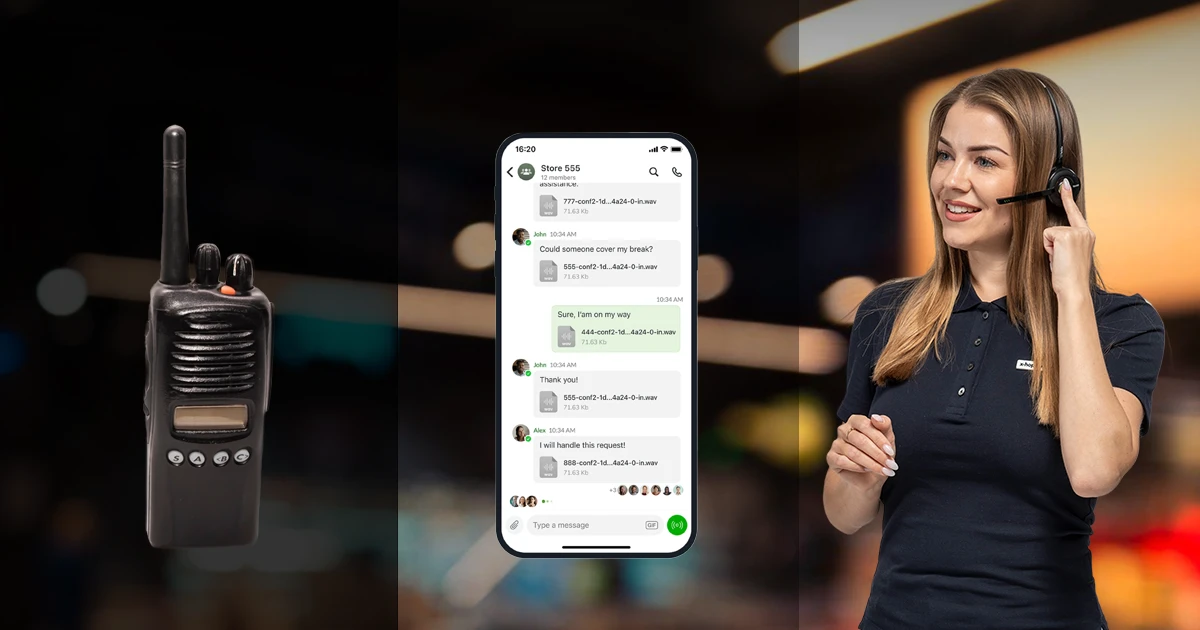
Push-to-talk, or PTT, is a system of voice communication where a person has to press a button to speak and release to hear a response. This is traditionally done in half-duplex audio, meaning only one person transmits at a time while everyone else listens, with no dialing and no ringing involved. A push-to-talk device is not a single product but a category with four types: traditional two-way radios, PoC (push-to-talk over cellular) radios, PTT apps on personal phones and dedicated retail headset systems. Each behaves very differently on a sales floor.
On top of that, most guides on push-to-talk devices are written for construction sites, warehouses or emergency responders. And their criteria are much different from what’s needed in a retail setting. They prioritize solutions that support large distances and are rugged enough to survive multiple drops. In retail, the focus is more on frontline staff looking approachable, handling high store noise levels, reducing dead zones in areas like concrete stockrooms, enhancing privacy for staff in front of shoppers and improving ease of use to speed up training during seasonal turnover. So, depending on the demands of your workplace, what makes the best push-to-talk devices for business can change.
This guide is designed to walk you through four types of these devices, how they actually hold up on a sales floor and how to figure out which one fits your store.
The four types of push‑to‑talk communication devices
Traditional two‑way radios
Analog walkie-talkies transmit over unlicensed or licensed radio frequencies. They offer a low upfront cost, require no monthly subscriptions and function entirely without a local Wi‑Fi or cellular network.
In a retail setting, however, their design comes with a few drawbacks. First, they are bulky and aren’t hands-free. And whether they’re held or clipped onto a belt, they still require at least one hand to operate. Their speakers broadcast every message to anyone within earshot, including customers, removing any privacy and creating a noisy in-store environment. Finally, their range rarely reaches inside concrete backrooms or walk‑in chillers, and they remain entirely isolated from other stores, headquarters and in‑store software or hardware.
Push-to-talk over cellular (PoC) radios
PoC devices look the same as standard two-way radios but transmit voice over commercial 4G, 5G or Wi‑Fi networks instead of a radio frequency. This setup extends the range, allowing multiple store sites to communicate over the same channel.
The trade-offs include recurring monthly data subscriptions per device and total dependency on strong indoor cellular coverage. Additionally, PoC units are still handheld devices and still isolated from the rest of your store systems.
PTT apps on personal phones (BYOD)
App-based push-to-talk relies on staff downloading software onto personal smartphones or using workplace mobile computers to send voice messages over Wi‑Fi or mobile data. This approach offers no upfront hardware expenses if store associates already carry compatible devices.
As always, there are drawbacks, particularly regarding bring your own device (BYOD) policies. Giving staff members access to their personal phones during a shift means they can easily be distracted by non-work-related tasks. In certain places, you can even be liable for the wear and tear on an employee’s device. Additionally, it still isn’t hands-free, but it also comes with push notifications that can pile up alongside personal texts and app alerts, adding to notification fatigue. High turnover also means constant reprovisioning, removing former staff and re‑adding new hires. And without dedicated hardware, there’s no reliable always-on channel, as the app has to be open and active to work.
Dedicated retail headset systems
Dedicated retail communication devices use lightweight, wearable headsets running on a DECT solution, providing secure, always-on voice channels. Depending on the type of push-to-talk headsets, the channels can either be limited to a single store or accessible to headsets in other stores, assuming they are connected through the same setup and have a channel-switching feature. For providers that offer a truly unified communication experience, supervisors and off-site managers can also join channels remotely via a mobile app, web app and/or by dialing in through a desk phone.
As an honest trade-off, retail headset systems can either carry a high initial hardware investment or be completely subscription based, which is more flexible but is an ongoing cost. They also require network configuration and deliver their greatest return on investment for mid-to-large store teams or expansive floor layouts. Their key advantages are their security, multi-store management support and, depending on the brand, their ability to integrate directly with broader store operational systems rather than simply providing on-demand in‑store communication.
Two-way radios | PoC radios | PTT apps (BYOD) | Retail headset systems | |
|---|---|---|---|---|
Hands-free
| No | No | No | No |
Range | Limited to line of sight / frequency | Wherever there’s cellular signal | Wherever there’s wifi or cellular signal | Store-wide via DECT, wider via mobile and web app |
Works between sites | No | Yes | Yes | Yes |
Ongoing cost | None | Per-device data subscription | App licensing, if any | Per-user subscription |
Conversation privacy | None, open channel | None, open channel | Depends on app, usually none | Encryption, configurable channels and targeted communication |
Noise cancelation | None | None | None | Noise-cancelling mic with crystal clear audio |
Integration with store systems | None | None | None | Connects to call points, IoT devices and store systems |
Onboarding new staff | Manual device handout | Manual device handout, SIM setup | App install, account setup | Fast, intuitive design, headset assigned at shift start, optional AI support |
Hygiene and shift sharing | Shared handset, no cleaning built in | Shared handset, no cleaning built in | N/A, personal device | Sanitary covers available, headband is easily removed and changed |
IT overhead | Minimal | Moderate, carrier accounts | Moderate, app and device management | Higher initial setup, low ongoing |
Five questions to consider before you decide
Choosing which push-to-talk communication system requires a little more than a comparison chart. To find the device that truly fits your store requirements, make sure you consider the following:
-
How much of your associates' daily job requires two hands?
If associates are constantly restocking, ringing up sales or carrying things, a handheld device is just another thing to juggle and risks slowing your team down. -
Are you managing a single site or multiple?
A single small store only needs to connect people who are physically in the building. But if it’s part of a larger chain and regional directors or off-site managers need to tune into stores remotely, basic radio frequencies won't cut it. -
Do conversations need to stay private in front of customers?
If staff regularly need to discuss something sensitive, such as a theft concern, a customer complaint or a staffing gap, without the customer or the whole channel hearing it, that rules out anything without targeted messaging or privacy controls. -
Does your communication setup need to trigger or receive external alerts?
Determine if voice alone is enough, or if your team needs real-time alerts from customer call points, self-checkout kiosks, stock level triggers and task management software. -
Who supports it when hardware or software fails?
Consider whether your store has on‑site IT resources to manage app updates and hardware provisioning, or if you need an enterprise platform with remote management and/or a managed service provider.
Understanding the true cost of push‑to‑talk systems
The sticker price of a device rarely tells the whole story. So, when budgeting for a push-to-talk solution, also consider the following costs:
- Upfront hardware: While basic handheld radios carry low initial hardware costs, enterprise-grade, durable devices carry higher upfront price tags due to specialized components, noise-filtering microphones or preloaded software.
- Per-user subscription: PoC radios and headset systems typically carry an ongoing per-device or per-user cost; radios generally don't.
- Replacement cycle: Handheld devices get dropped, lost and worn out, especially in a high-turnover retail environment, and that replacement cost adds up over a year unless replacements are included in a monthly subscription.
- The hidden cost of downtime: A lost handheld, a dead battery mid-shift or a device sitting uncharged in a drawer all mean there’s a staff member without a way to communicate with the team when they need to. That's a cost that can be hard to calculate, but directly impacts not only staff efficiency, but also product availability and customer satisfaction.
Where x-hoppers fits: Beyond headsets and traditional PTT
x-hoppers sits firmly in the fourth category as an advanced, unified communications platform that combines headset-based push to talk communication with both a web and mobile app and optional full telephony. It also provides:
• Smart call points Smart call points: Customers can request help at locked display cases or service desks by scanning a QR code, which instantly sends an audio alert to the general broadcast channel, or only to specific employee groups.
• Automated system alerts: Self‑checkout machines, computer vision solutions, smart shelves and other IoT devices notify associates when there’s an issue without having to stare at screens, streamlining tasks and helping teams serve customers quicker.
• AI assistant: Employees can ask questions directly into the headset regarding store policies, stock levels or product information and receive immediate, accurate audio answers.
• Remote manager access: Store managers and area leaders can stay connected to store channels via the mobile app from anywhere without wearing a headset or being in store.
• Analytics and real‑time transcriptions: Retail leaders can get detailed information of what’s happening in stores through searchable transcriptions, detailed retail analytics on both user activity and alerts from integrated systems and even analysis of the AI assistant’s answers, giving managers a comprehensive view of training gaps and any reoccurring in‑store issues.
Which type fits your store?
Every business is different, and only you know what your store truly needs, but on average:
- Small independent stores usually work well with basic two-way radios, since they’re cheap, require no subscription fees and are easy to hand out at the start of a shift.
- Single large-format stores tend to benefit more from dedicated headset systems since they provide better coverage in traditional dead zones, offer more privacy and can integrate with store systems.
- Growing multi-site chains require more visibility and the ability to talk store to store (or headquarters to store), making headset systems the best option. Because while PoC radios can cover multiple stores, only a headset system that forms part of a unified communication solution can cover range, privacy, integrations, detailed analytics and remote manager visibility all at once.
Hopefully now you have all the information you need to make an informed decision about which push-to-talk device is right for you. And if that happens to be x‑hoppers, the smart retail headset solution, then please speak to a member of our team and we’ll help you do more than just connect one store — we’ll work with you to connect your entire business.
Frequently asked questions
What are push-to-talk devices?
Push-to-talk devices are hardware units, or software running on existing devices, that let people communicate by pushing a button, speaking, then releasing the button to hear a response. The category includes two-way radios, PoC radios, PTT apps on personal phones and retail headset systems.
How does push-to-talk work?
You press and hold a button, say your message, then release the button to return to listening. In half duplex systems, only one person can transmit at a time on a given channel, and the message reaches everyone listening instantly. On a full duplex system, anyone can speak at any time, but the system uses PTT to keep individuals muted when they aren’t talking to reduce noise on the channel.
What is the difference between push-to-talk and a phone call?
A phone call requires dialing a number, waiting for the recipient to answer and allows an instant, simultaneous two-way conversation. Push-to-talk connects instantly at the press of a button to a dedicated channel to share updates to an entire team at once.
Are push-to-talk apps as good as dedicated devices?
While PTT apps turn existing smartphones into store communication tools, they require unlocking screens, drain phone batteries quickly, can cause notification fatigue and lack the hands-free convenience and durability of dedicated push-to-talk devices.
What is push-to-talk over cellular (PoC)?
Push-to-talk over cellular (PoC) is a technology that uses commercial 4G, 5G and Wi-Fi networks instead of traditional radio frequencies to transmit voice messages. That gives it a far greater range, allowing it to connect different sites, but it is highly dependent on cellular coverage and usually comes with a per-device data subscription.
Do push-to-talk devices work without Wi‑Fi or a mobile signal?
Traditional two-way radios do, since they transmit over a dedicated frequency and don’t need a network at all. However, modern PoC devices, smart headset systems and mobile PTT apps rely on Wi‑Fi, cellular coverage or an in-store network (such as DECT) to function.
Why are push-to-talk devices expensive?
The upfront device cost is only part of the picture. Ongoing subscriptions, a realistic replacement cycle for lost or damaged handhelds and the hidden cost of downtime when a device dies or goes missing mid-shift all add to the real, total cost over time.
Commercial-grade PTT hardware is built for durability, long battery life, specialized noise cancellation and secure network connectivity, which explains the large upfront cost. However, the total cost of a solution also includes software licenses, system integrations and support — if needed.
What is the best push-to-talk device for a retail store?
It depends on the store. A small, single-floor operation on a tight budget may be fine with a basic two-way radio, while a larger store or a growing multi-site chain generally gets more value from a dedicated headset system that adds privacy, integration and remote visibility for managers.
Can push-to-talk headsets be shared between shifts?
Yes, dedicated retail headset systems are generally designed for this and can include an easy way to change headbands, earphone covers (if needed) and allow for user sign on, so all messages and calls go to the right person the first time.