


If you’ve ever worked a busy Saturday in a large department store, you know how everything seems to happen at once. As soon as a cashier needs a price check, a stockroom associate has a question about a delivery. All while a customer in the furniture department demands a comprehensive list of mattresses suitable for a loft bed. Without a solid communication system, employees end up wandering the store looking for help, leading to ballooning wait times and lost sales.
But if everyone’s on the same comms system, like a radio channel, there’s a different friction — too much noise. In fact, the constant irrelevant chatter can lead to missed messages and distracted or frustrated staff.
Both extremes kill efficiency and drain your teams. But there is a way to have it all: targeted communication that still lets you have the power to instantly connect teams with anyone, anywhere, when needed.
And what might this magical marvel be? Simple: smart broadcasts.
Introducing smart broadcasts: Communication that understands your store
A broadcast, or channel, is where multiple people can send or receive voice messages and be heard by all participants at the same time. Walkie-talkies are the most well-known devices to use this method of communication, but other in-store communication solutions, such as DECT headsets, also offer broadcasts with push-to-talk or even hands-free modes. The problem with these basic technologies is that:
With radios, you:
- Can only have one person speak at a time
- Risk anyone picking up the broadcast
- Have to carry them around either on a belt clip or in your hand
- Can’t integrate them into any other communication or smart technology
With basic DECT headsets, you:
- Have clear, secure sound
- Can wear the device, so your hands are always free
- Can integrate it into other systems, including telephony, depending on the headset's software
- May have full duplex communication, but are tied to one broadcast per store
However, if you have a communications solution that supports multiple, smart broadcasts, you get all the advantages of basic DECT headsets and the ability to keep communication targeted and helpful.
What does this look like in practice? Well, a system that supports an unlimited number of dedicated broadcasts lets you create focused communication channels for different departments, roles or even entire stores.
For example, you could have a “checkouts” broadcast, a “stockroom” broadcast, a “managers” broadcast and so on. This immediately cuts down on unrelated chatter. Messages relevant only to cashiers stay in the “checkouts” broadcast, while managers can speak confidentially across the store. Add in the ability to use natural voice commands to switch between broadcasts, and you have a solution that effortlessly creates a communication network that is both focused and fully connected.
Targeted messaging
Smart notifications
Another unique feature of smart communications solutions is that you can integrate them with other smart devices. So instead of hoping your associates see the flashing red lights above the self-checkouts, you can send automated alerts straight to their headsets, ensuring they know whenever a customer needs assistance.
Of course, you could have all of the self-checkout alerts sent to everyone in the store — and in a small store where everyone is responsible for customer service, this is best practice. But if you have employees on separate floors or only certain teams that are trained on the machines, then it’s better to direct them to specific broadcasts or call groups.
This is particularly true for security. Whether you have computer vision software, RFID tags or other anti-theft technology, with smart notifications, you can make sure they only go to the security broadcast. This way, only trained security personnel are alerted to would-be thieves, ensuring the situation is handled appropriately and according to your store policy.
Scheduled messages
Let’s imagine that instead of a department store, you’re managing a large home improvement store. You need to make sure the garden center team is aware of a new seasonal flower delivery. You could simply jump onto the garden center broadcast and tell the team, but if you’re in on the late shift and the delivery is arriving in the morning, you’re dependent on an associate remembering or adding it to their handover.
Instead, with a smart communications solution like x‑hoppers, you can open the web app and schedule a text-to-speech message that will play only to the garden center broadcast for the morning. No need for detailed handovers or team huddles, all your important updates can be scheduled and shared, so no one misses a thing.
Connecting multiple stores
The best part? The same flexibility and connectivity isn’t limited to one store; it can extend across an entire regional or national chain.
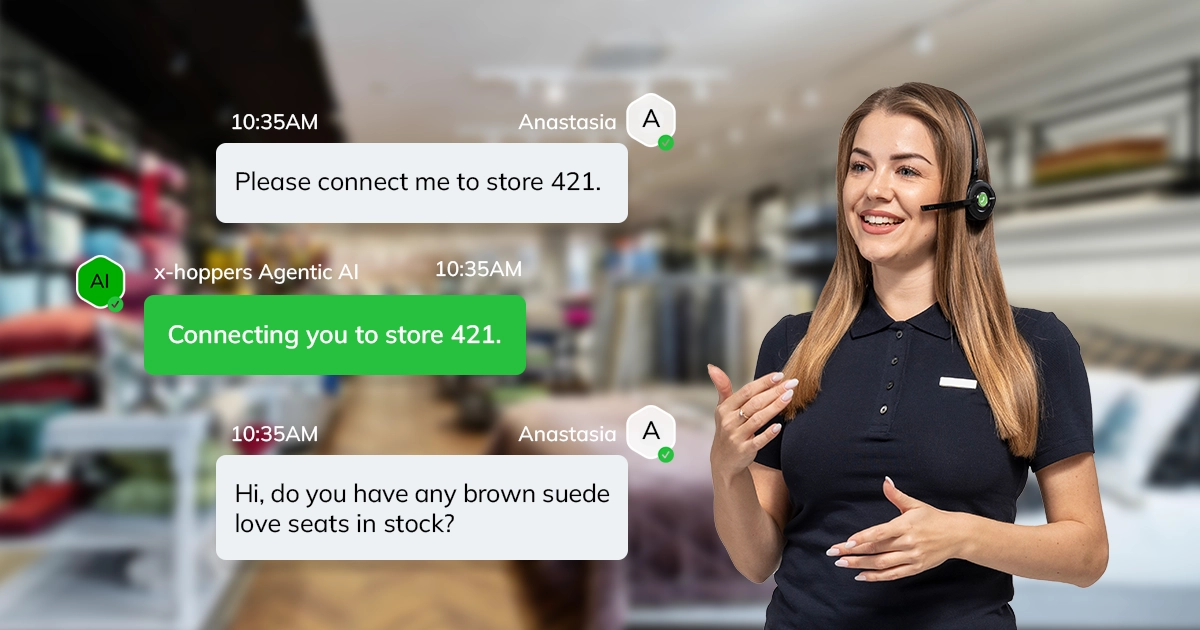
Imagine an associate at “store A” is helping a customer find a specific size of a popular jacket, but they’re out of stock. Normally, that’s the end of the sales conversation. With a voice-powered AI assistant and access to multiple broadcasts, the associate can simply switch to the “store B” broadcast and ask the team at the neighboring store if they have the item, get a real-time answer and arrange for the customer to pick it up then and there.
Sound exciting? Then imagine what easy access to multiple broadcasts does for regional managers. Using the mobile app, a manager can have a “bird’s-eye view” of multiple stores or departmental broadcasts wherever they are. Without stepping foot into a store, they can quickly review transcribed conversations in real time or join a broadcast to offer guidance and share time-sensitive updates. Alternatively, they can sign into the web app and use the message scheduler to broadcast information on a promo to every store in their region simultaneously.
Conclusion: The strategic value of targeted communication
Too much communication can be just as detrimental as not enough. With smart broadcasts, you can finally strategically target communication without siloing your teams, leading to:
- Reduced noise: Employees only hear the messages relevant to them, improving focus and reducing errors.
- Faster problem-solving: Direct access to the right expert, whether in the next aisle or the next town, means quicker solutions.
- Improved collaboration: Silos between departments and stores disappear, fostering a culture of a single, unified team.
- Better management oversight: Leadership can target communication with precision and gain real-time insight without overwhelming staff.
Smart broadcasts are more than just a unique feature; they are a fundamental tool for building a more efficient, responsive and intelligent retail operation at scale. You just need to choose a communications solution that not only supports them, but unifies all your communications from IoT alerts to telephony on one platform.
The x-hoppers advantage: One powerful platform
x-hoppers is the only retail communications solution designed to help you create truly connected stores.
With x-hoppers, you not only get smart headsets, a powerful mobile app and the agility to set up multiple smart broadcasts, you also get:
• Powerful integrations: Thanks to x‑hoppers’s open APIs and 500+ ready-to-go integrations, we’ve got you covered whether you’re using well-known software or a custom in-house solution. And since our system is based on Wildix technology, we can connect legacy doorbells as easily as the newest retail software or IoT devices.
• Built-in telephony: With x‑hoppers, telephony isn’t an add-on; it’s built into the core of our system. Your associates can answer external customer inquiries or use dial-by-name to call external suppliers, warehouses or customers without ever taking off their headsets or leaving the sales floor.
• Smart call points: By placing QR‑code-based smart call points in high-friction areas, such as fitting rooms or near locked cabinets, shoppers can trigger an automated message to the relevant team with a simple scan. This empowers your teams to provide quality customer service without investing in additional hardware.
• Real-time retail analytics: By analyzing response times and even key phrases, our retail analytics can help you uncover staff training needs and provide informed feedback. And since every smart notification from smart call points to camera integrations is also analyzed, you can identify operational bottlenecks, optimize staffing levels and quickly identify changing customer preferences.
Ultimately, the choice of how you connect your store comes down to your specific goals, but regardless of the platform you choose, make sure it’s one that removes friction rather than adding to the noise. Whether you are looking to refine a single location or unify a national chain, prioritize a system that empowers your frontline to stay focused, stay informed, and — most importantly — stay by the customer’s side.
Looking for a smarter way to connect your stores? Speak to a member of our team to see how x‑hoppers can reduce noise and boost collaboration across your entire business.