


We’re already firmly in the Golden Quarter, which means that holiday hiring is well underway. But once the selection process is over and your stores are flooded with eager new faces, how do you plan to teach them where things are, how your systems work and what to say to an impatient customer?
The traditional answer is to pull new hires off the sales floor for training. And if that’s what you’re planning, you risk losing precious time when your stores are at their busiest. Here’s how I’d approach it instead.
Moving from "classroom learning" to "knowledge on demand”
Front-loading training in the first few days or weeks in an environment that’s disconnected from an associate’s daily work has two problems that are amplified during peak.
First, it takes people off the sales floor when you need every pair of hands. A new hire sitting through a module in the back room is an employee who isn’t helping a customer, and any experienced associate running the session isn’t either.
Second, it doesn’t stick. A new starter can sit through an hour of product and procedure information and still freeze the first time a customer asks a detailed question. Knowledge that isn’t used immediately or learned in context tends to fade fast, and seasonal hires rarely get a second session.
The result is a pattern most retailers will recognize: a rushed orientation, a nervous first week and a team of experienced colleagues fielding the same questions from customers and seasonal workers over and over again.
The principle I’d build onboarding around is simple: training should happen in bite-sized pieces on the sales floor, in the moment it’s needed, rather than in a separate session before the first shift.
It sounds ideal, but with the following in place, it’s not only possible; it’s a proven method.
-
Answers have to be in real time.
If a new hire has to find a manager or walk to a terminal, they've already lost the customer's attention. They need instant access to information wherever they are in the building. -
Asking has to feel safe.
New starters often stay quiet or invent answers rather than look unsure in front of a customer. A private, low-stakes way to access information removes that hesitation and boosts employees’ confidence. -
Experienced colleagues should be reachable without being interrupted.
Your experienced associates are your best training resource, but only if helping a new hire means they don’t get pulled away from the customer in front of them. -
Eyes need to stay up.
Anything that makes associates look down at a screen or ties up their hands is competing with the job they're trying to learn.
This is where I think smart headsets change the equation.
What headset-based training looks like in practice
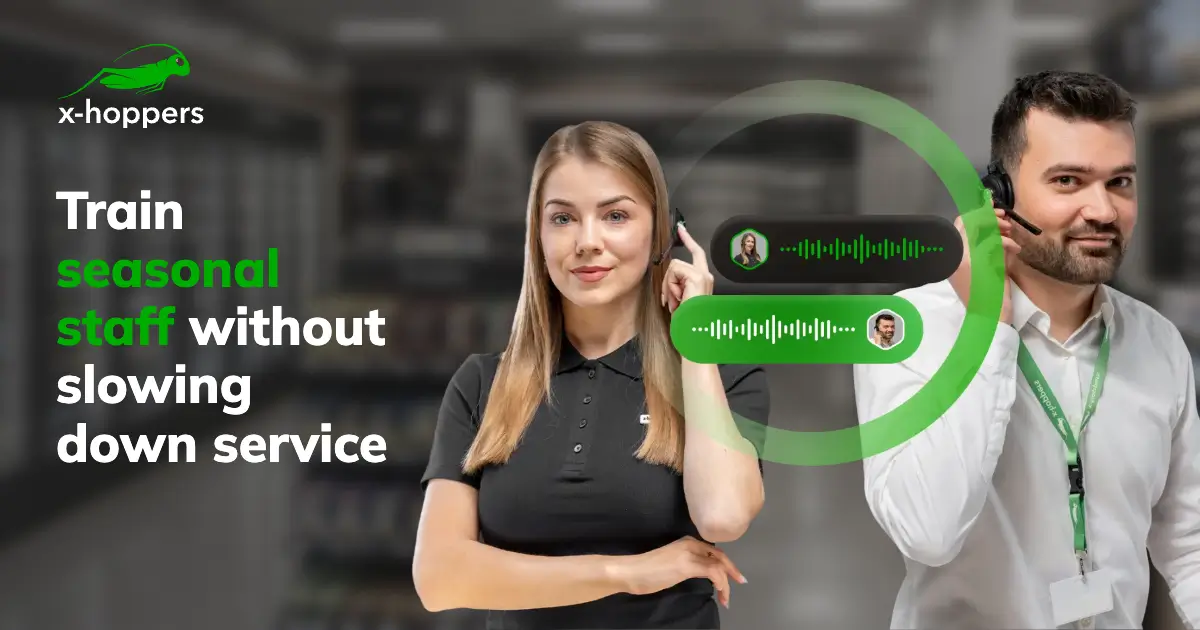
A smart headset keeps a new hire connected to the people and information around them without taking them off the sales floor or forcing them to look down at a screen. Specifically, they can access:
-
Live answers delivered discreetly in their ear.
With a voice-powered AI assistant connected to your product and procedure data, a new starter can ask a question in natural language and hear the answer immediately. They don't need to know where the stockroom log is or how a return works on day one, because the answer is a question away. And because the assistant draws from your own systems rather than the open web, the answer matches how your store actually operates. -
Learning by listening.
Over a store broadcast, a new hire can listen in on experienced colleagues handling real situations in real time: answering customer questions, solving stock problems or even coordinating cover at the checkouts. It's a bit like job shadowing without having to physically stand next to a colleague. For someone working on their own in a department, being able to hear those conversations is a real confidence boost. -
Help without the audience.
When a new starter does need a hand, they can reach a colleague or a manager directly rather than searching the store and waving someone down who is serving a customer. That keeps the interaction smooth and spares the new hire some of the awkwardness that makes some people quit within their first few shifts. -
Fewer interruptions for experienced staff.
When the AI assistant answers routine product and process questions, your experienced associates get fewer of the repeat questions that pull them away from their own customers. Instead, their time can be better spent on keeping the store in order, coaching new hires or serving customers.
Identifying knowledge gaps
Now, even with all the features listed above, you can’t assume all new hires are learning or using the system at the same rate. Which is why having easy access to data, analytics and AI-powered insights makes a noticeable different.
In a normal peak week, a manager has dozens of things competing for their attention and no easy way to know which new hire is quietly struggling. But if the questions seasonal staff ask are captured and aggregated, patterns start to show up. For example, several new starters might ask about the same product category or the same returns procedure keeps coming up. These insights tell you where your onboarding material has a gap, and it lets a manager coach in the moment rather than discovering a problem after the season has ended or the employee’s left.
A practical approach for the next few weeks
If you’re about to bring on seasonal staff, here’s how I’d structure it.
1. Keep the upfront session short.
Cover safety, the basics of your systems and what to do if they get stuck. Aim to get people on the sales floor quickly rather than trying to teach everything at once.
2. Make sure every new hire is on the relevant channel.
This is more if your store is large and you have a retail headset system with different broadcasts for different departments. (If you don’t have a headset system, make sure they know who their “buddies” are.) Make sure they can hear the team they’ll work the closest with so they can easily reach their colleague from their first shift.
3. Give them a fast way to get answers.
Whether it’s an AI assistant or another instant resource, the goal is that no new starter is ever stranded without help or access to the information they need.
4. Check in on patterns, not just people.
Look at what new hires are asking and adjust your guidance while the season is still in motion.
5. Keep the learning going.
Treat the first week as the start of training rather than the end of it, and let experience build on the sales floor, shift by shift.
None of this removes the need for good managers or a welcoming team culture. It just means the knowledge and support new hires need are available at the moment they need them, rather than locked in a session they attended weeks ago.
How can x-hoppers help?
Since we built x-hoppers for the reality of retail, we designed them to be more than just a tool for one-to-many broadcasts. We designed them to connect associates to not only people, but to the systems and data they need to do their job well.
Our smart headsets keep every associate connected to an always-on store broadcast, so new starters can learn by listening as well as by asking. Our AI assistant answers product and procedure questions on demand, delivering information straight into associates’ ears, and managers can follow store activity through the mobile app and analytics to spot knowledge gaps early. Retailers using x-hoppers have reported a reduction in training time, which makes a huge difference when your seasonal team only has a few weeks to get up to speed.
If you’re planning your holiday hiring now, it’s a good moment to think about how your new starters will learn. If you’d like to learn more about how x-hoppers can help your staff learn on the sales floor, speak to a member of our team today.