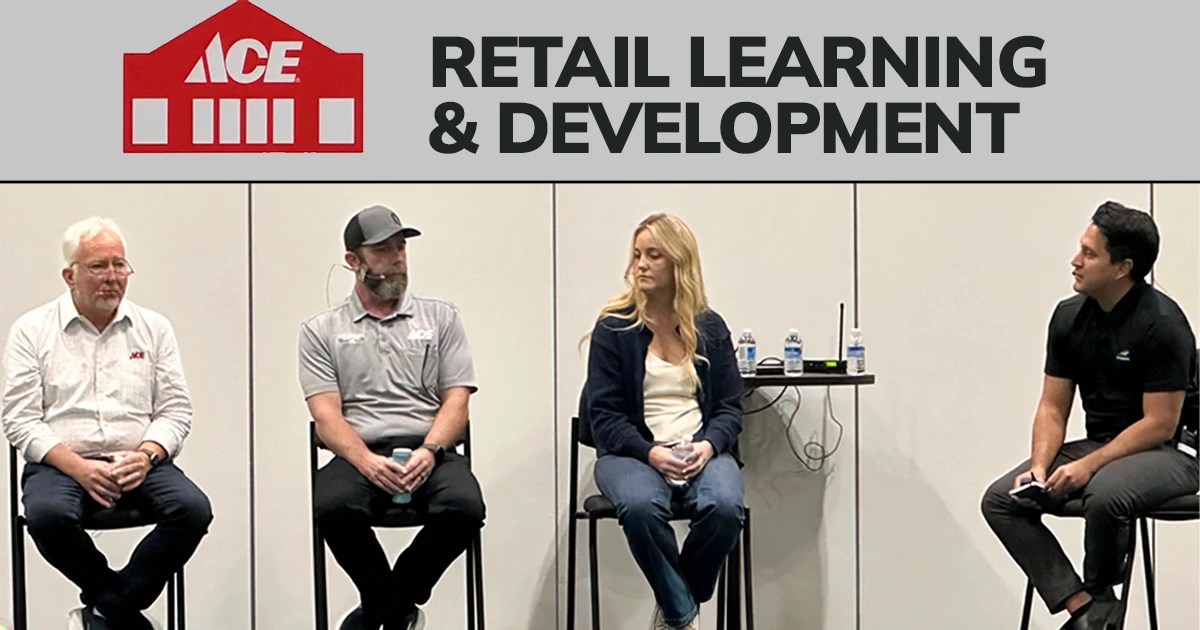
At the recent Ace Fall Convention, I had the privilege of hosting a panel alongside Bob Lovesky, Store Operations Sr. Manager, to discuss a major shift happening in Ace stores: a move away from walkie-talkies to x‑hoppers’s smart retail headsets.
Previously, if a customer needed an item that was out of stock at one location, employees had to call another store and wait while someone checked the shelf. Now, employees simply jump into the other store’s broadcast channel via their headset and ask:
“Hey, can somebody check a quantity for me?”
An associate in the other store can instantly confirm the item is available and hold it for an incoming customer.
“It’s just really streamlined the process,” shared Charlie. “It’s made it a lot easier on the customer. It’s easier on the employees. It’s just it’s all around easier for everybody.”
Yelling across the store or paging colleagues to answer an incoming phone call creates unnecessary stress for staff and customers alike. With x‑hoppers, staff members just put on a headset and can immediately and discreetly ask for help or transfer phone calls directly, without ever having to pick up another device.
As Charlie put it: “Normally they’re not yelling at each other, but when you raise your voice and you get a little tone, sometimes people just get crossways. It’s almost completely eliminated paging for phone calls. I’m not constantly hearing that phone going off.”
So now, instead of paging someone and saying, “Hey, so and so line 1, so and so line 2 just they do it through the headset and they say, hey, you’ve got a call. And if they’re busy, they can say, hey, take a message, I’m with the customer instead of paging it repeatedly until they pick it up. The store feels calmer now, less tension, absolutely, and better collaboration, which at the end of the day is what we’re trying to achieve.”
AceNet orders have to be accepted within 15 minutes. Before x‑hoppers, Charlie used a loud tablet alarm to notify staff of incoming online orders, which often led to missed alerts or multiple employees rushing to pull the same item. Now, AceNet order notifications play directly into the headsets. “They accept the order and everybody hears it. It goes to everybody,” Charlie clarified. “Everybody knows who’s pulling it. There’s no confusion, no miscommunication. And since we’ve adopted this, we’re at 100%. All three stores haven’t missed an order.”
With employees who have been with him for more than 20 years, Charlie expected resistance. “Anytime there’s change, you’re always going to get some pushback from people,” he said. “Honestly, there hasn’t been any, really. I think they see the value in it. We’ve got several employees that are 70‑plus years old and they use it. I was expecting at least a learning curve for a new technology, but it’s just so simple that there’s been none.”
Bob was in Charlie’s store on the day of the install and saw the same thing. “By the time we left, they all had it on and they were using it,” he told the room. “No training. We didn’t have a big training session or anything. They just went to it and did it.”
When asked why he chose x‑hoppers, Charlie had this to say, “I think just the overall improvement in communication, it’s just a better system. Everyone is more connected. They’re working together better. We’re finding new uses for it every day.
And honestly, when I started this, I thought, well, that’s a great idea. Can I afford it? That was my first question. This has got to be expensive. When I saw how inexpensive it was, I thought I’d be stupid not to do this. I mean, even if you don’t like it, it’s a drop in the bucket compared to what we spend every day in this business for things that are not near as useful. So it pays for itself.”
Scott tapped into Wilma, our AI tool that’s built into the browser version of the platform and can pull data on any x‑hoppers communication channel. Even when he isn’t on‑site, Scott asks Wilma questions like “Tell me about about yesterday” to receive a clear summary of sales floor activities, team roles and customer questions based on the transcriptions of internal staff conversations. As he puts it, “There’s a lot of intelligence in there that we’re still just scratching the surface of.”
Through these AI summaries, Scott discovered how frequently customers were asking for items his store did not carry, giving him direct insight into new inventory opportunities.
“I was amazed to learn how many times we get asked for Pokémon cards,” Scott said. “And I probably would never have known that because they don’t necessarily tell me what customers ask them for that we don’t have. So I’m learning a lot about that every day now. That’s kind of new.”
With x-hoppers, new employees can speak directly to Hey ARMA via their headsets to ask questions or locate product SKUs without having to look down at a screen or walk away from customers.
“We can speak to Hey ARMA in the headset and you can ask ARMA whatever so employees don’t have to pick the phone up while they’re with a customer anymore,” Scott explained. “The customer just thinks they might be talking to somebody on the other side of the store. So new employees get real comfortable real quick and learn. They just learned everything about the store.”
Scott replaced his aging handheld devices and high phone bills by switching his telephone system to x-hoppers.
“So the first conversation was about just replacing the radios. And then during that I said, what do you do phones too? And you were like, yeah, we do phones. Well, it was a lot cheaper actually, when it’s all said and done. And everything gets recorded and feeds into the one system… It’d be silly for me to have anything else.”
Bill’s Ace Hardware replaced costly call boxes with smart QR code call points. Placing QR codes across the store, including on locked display pegs, propane stations, paint counters and yard gates, allows customers to scan for help instantly. When scanned, an audio alert plays into the headsets, and the team is automatically notified after the first associate accepts the request.
“We’ve been able to put them in a lot more locations than having the very expensive call boxes,” explained Jordan. “So we’ve got probably upwards of 60 QR codes in a store. It really allows us to meet the customer where they are a lot more quickly whenever possible.”
x-hoppers provides back-end analytics detailing average response times and missed requests. After discovering that response times were lagging at the yard gate and electric, Jordan’s management team pulled analytics reports to train staff on prioritizing those touchpoints.
“In California, we have a lot of stuff locked up,” Jordan said, and her stores relied on call boxes at each cage and yard gate. She wasn’t sure customers would take to scanning a QR code instead.
“It’s gone really well and the adoption’s been a lot better than anticipated,” she said. Because QR codes cost far less than call boxes, she has also been able to put them in many more places. “We’ve got probably upwards of 60 QR codes in a store. Every aisle, every service touchpoint. It really allows us to meet the customer where they are a lot more quickly. When a customer scans a code, an alert plays in the headsets and repeats every 30 seconds until an associate accepts it. The whole team then hears who is on their way.”
The analytics behind those scans showed Jordan something she couldn’t see before: how long each touch point waits for a response. The yard gate and electrical stood out.
“We found that it was actually up to 84 seconds for us to get to the furthest call,” she said. “There’s a reminder every 30 seconds, so almost three times, and no one of the 30 people on shift was accepting that call to go help that customer. And then I figure it’s going to take us another 60, 120 seconds to get there. We cannot leave a customer waiting for four minutes.”
Her team now downloads the report, goes through the longest response times with the management team and works on them with staff. Jordan checks for herself too: “I even go around and I scan them and I see how long someone’s going to take to get to me.”
For Jordan, x-hoppers is all about maximizing labor efficiency without overburdening the team. “We need to look at opportunities in each of our own businesses and what we can do that’s going to help us make better use of our labor, because that’s one of our highest expenses, and anything that is going to be able to give us better service to the customer. And x‑hoppers is a solution that allows us to meet those two needs.”
Whether it is eliminating overhead noise, bridging communication between multi-store locations or using AI to understand floor dynamics, the Ace owners on our panel proved that wireless smart headsets do far more than provide a push-to-talk broadcast channel. They give retailers the visibility, speed and tools needed to deliver a better customer experience.
Thank you to Charlie, Scott and Jordan for sharing their insights with us at the Ace Fall Convention!