



It’s no secret that the “death of the high street” narrative was a bit of an exaggeration. Physical retail is here to stay — but the bar has definitely been raised. Today’s shoppers arrive in-store with their research already done and their minds mostly made up. They’re looking for the same speed they get online, but with the added value of real human connection. And when that service isn’t there? They don’t hesitate to walk out the door.
Meeting that demand for instant, expert service is the new gold standard, but for many retailers, getting it right is harder than it first seems. To help, we set out to uncover what’s actually happening on the sales floor by commissioning independent research and surveying over 2,200 consumers and retailers across both the U.S. and the UK.
Interestingly, while everyone is feeling the pressure of a “service gap,” it turns out both sides of the Atlantic are taking some pretty different paths to fix it. Here is what we found when we put the two datasets side by side.
Plan of action: U.S. retail is playing catch‑up
Perhaps the sharpest contrast between the two markets is how far along each one is in formalizing a connected store strategy. In the UK, 76% of retailers have a documented connected store strategy with dedicated budget and a roadmap. In the U.S., that number drops to 55%, with 44% of American retailers still operating without any formal strategy in place. That’s nearly double the rate seen in the UK.
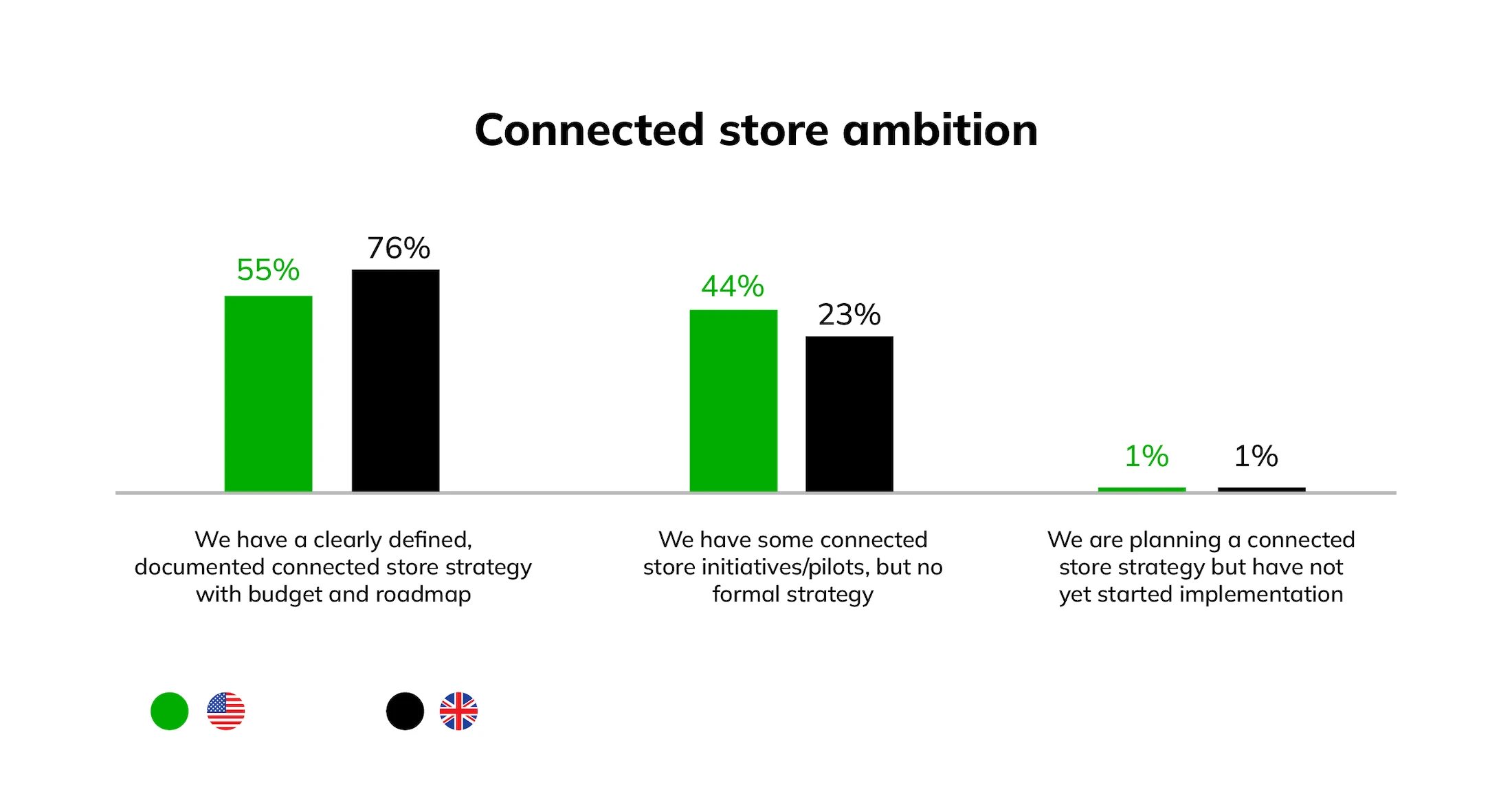
What’s particularly interesting is it’s not due to valuing connected stores less — U.S. retailers are clearly investing in connected store technologies across the board — but of strategic cohesion. Without a formal strategy and roadmap, individual technology investments are more likely to operate as isolated tools than as parts of a coherent system, which can create, instead of removing, some of the frictions on the sales floor.
The encouraging sign is that the model clearly works when it is actually deployed. In both markets, 99% of retailers who have launched connected store initiatives report being very or somewhat satisfied with the results. So, if you haven’t started building a connected store strategy yet, all you need is a clear direction and implementation plan to get the most out of your in‑store technology and boost the shopping experience.
Operational friction: The same problems, different intensities
When you dig into the day-to-day pain points, the two markets start to converge. It turns out, disconnected systems and communication gaps aren’t uniquely American or British problems; they’re the defining challenges of modern retail. However, the data suggests the U.S. is feeling these issues a bit more acutely on the frontline.
In the U.S., a staggering 79% of retailers admit their associates have to physically leave a customer’s side just to find an answer, whether that’s checking a computer terminal or hunting down a manager. In the UK, that number is significantly lower at 50%, but British retailers face a different kind of “silo trap.” Nearly half (46%) of UK retailers say their various systems simply don’t talk to each other.
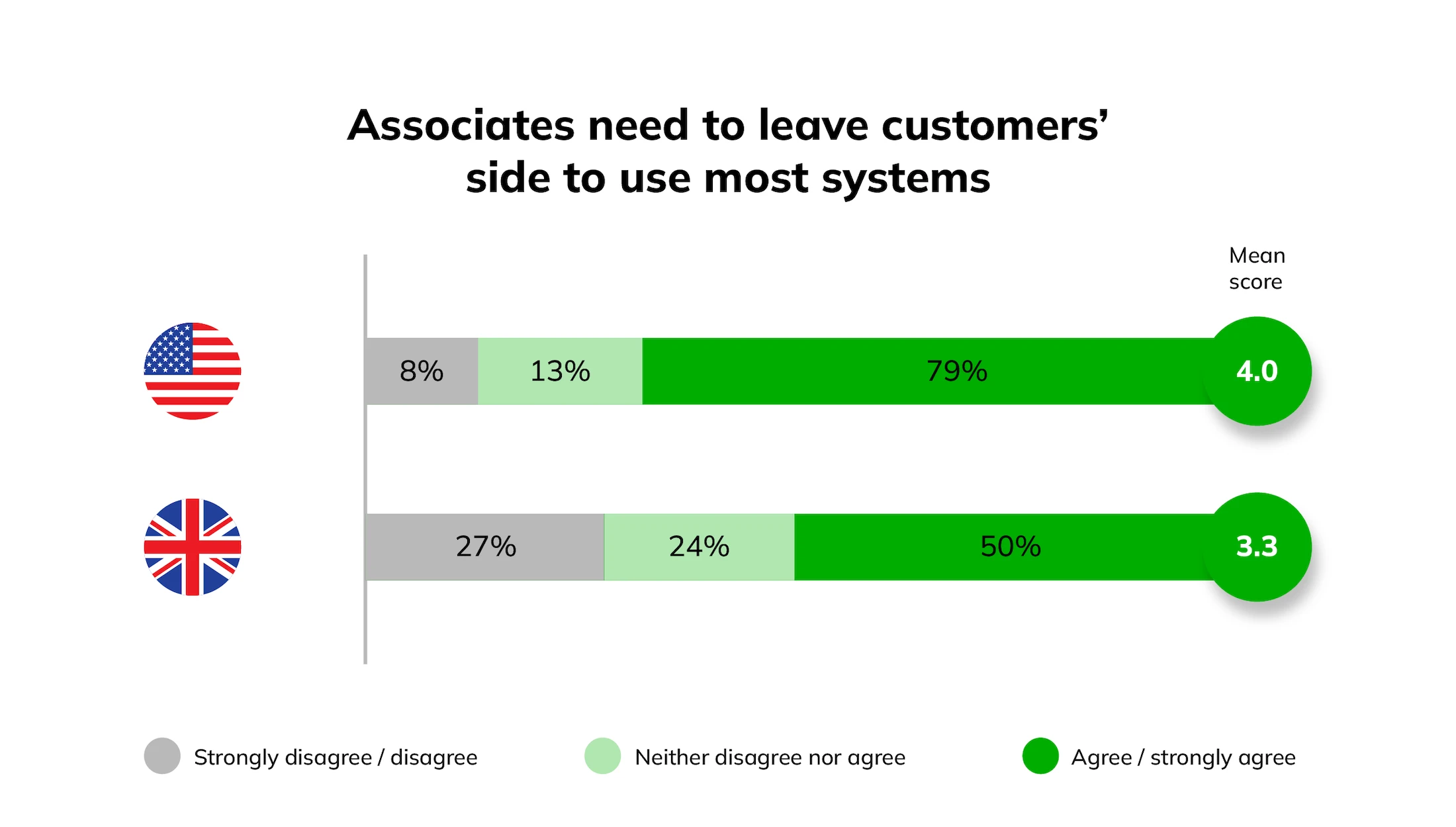
The result in both markets is the same: managers are left with “blind spots,” and associates are often the last to know what’s actually happening. And this lack of communication and easy access to knowledge means that associates often have to walk away from a customer to find information, making it more likely for shoppers to become frustrated and abandon the purchase. It’s a direct hit to the bottom line caused by a patchwork of tools that don’t quite fit together.
We also found a shared struggle when it comes to getting new team members up to speed. In both the U.S. and the UK, about 46% of retail leaders say their store systems are difficult for new employees to learn. In an industry where turnover is naturally high, slow onboarding isn’t just a temporary glitch — it’s a persistent drag on service quality.
Ultimately, this operational friction isn’t a “people problem.” Associates aren’t failing to find answers; the infrastructure around them is just failing to help them access and deliver those answers fast enough.
What customers want: Speed, knowledge and consistency
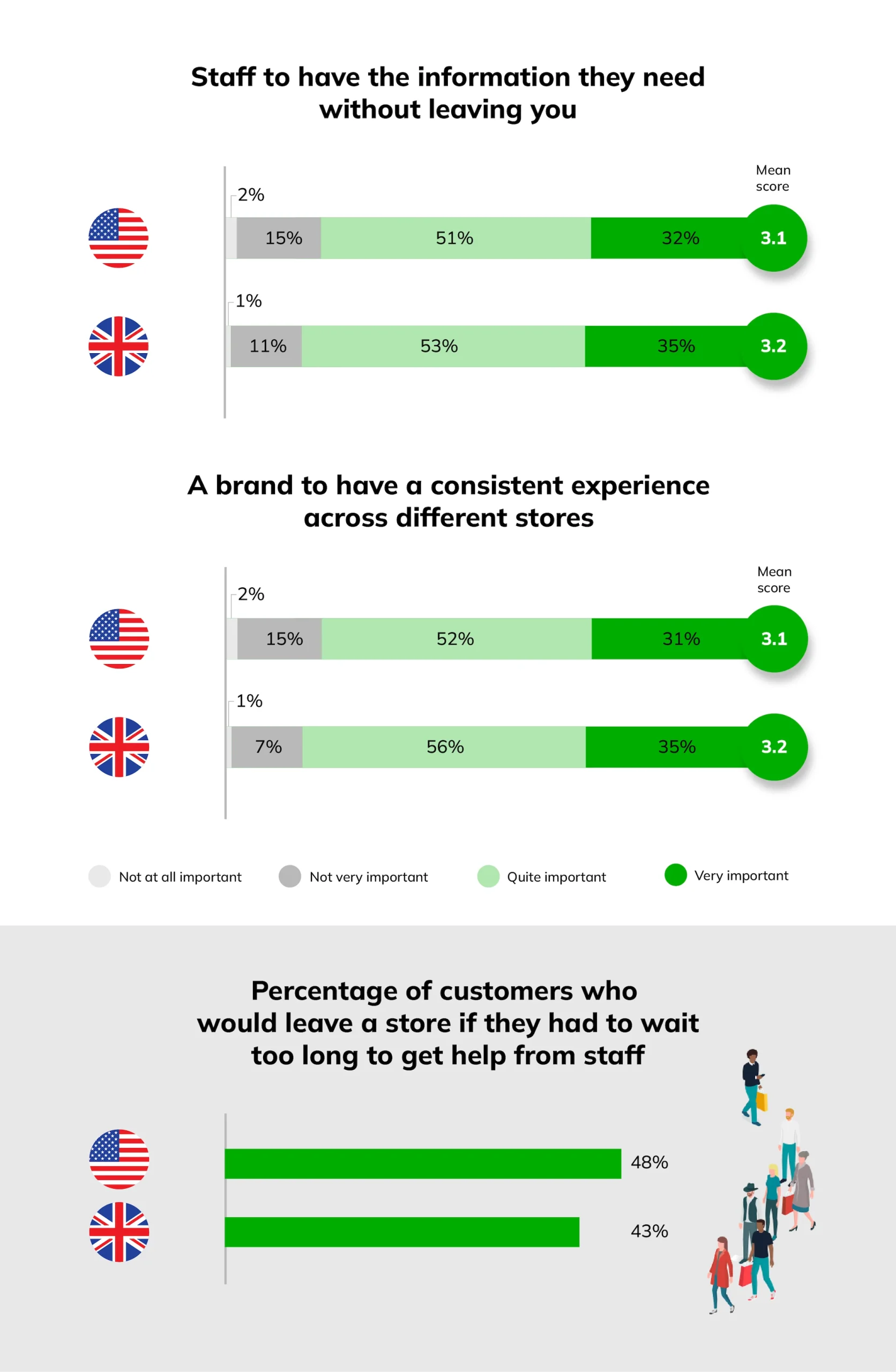
Across both markets, what shoppers are looking for is strikingly consistent. Whether they are in Manchester or Miami, they want help quickly, they want staff to have the answers without walking away and they want the same quality of experience no matter which branch they visit.
UK consumers set the bar a little higher, particularly when it comes to brand consistency (91% vs. 84%) and on-the-spot knowledge (88% vs. 83%), but the overall trend is identical. In both markets, being made to wait isn’t just a minor annoyance; it’s a trigger that pushes them out the door. In fact, 48% of U.S. consumers and 43% of UK consumers say they’ll simply abandon a purchase if help takes too long. This is a commercial loss that often happens quietly. There’s rarely a formal complaint or feedback, just a lost sale and a customer who likely won’t be back.
How important is it for:
The path forward: Generative AI and human connection
Despite the differences in strategic maturity, both markets are focused on the same silver lining: technology that empowers people.
In the UK, 58% of retailers have identified staff-facing generative AI as a top priority to bridge the training and knowledge gap. While in the U.S., it sits in the top five. The logic is consistent across both: if an associate can access accurate product information and procedural guidance through an easy-to-use interface, the knowledge gap closes in real time without requiring a longer training program, a more experienced associate or a manager being physically present on the floor.
Interestingly, shoppers are more than ready for this. 70% of U.S. consumers have a positive view of staff using headsets and AI to provide instant answers, with support being particularly strong among older age groups. In the UK, Millennials lead the charge with 75% in favor, but positivity is consistent across all age groups.
67% of U.S. consumers go even further by specifically stating they want connected stores where staff can provide instant answers without leaving their side. As we can see, the demand isn’t specifically for more gadgets; customers want better-informed staff, and are more than happy with the technology that supports that.
The missing link: From fragmented tech into stellar in‑store service
When you read both reports together, it’s clear that U.S. and UK retail aren’t facing fundamentally different problems. They’re just at different stages of the same journey.
UK retailers have the strategic infrastructure but need to close the integration gap between their systems. U.S. retailers have the investment intent and consumer demand, but they need to move from isolated tools to a coherent system that connects people, data and systems in real time.
In both cases, the solution is the same: a hands-free, easy-to-use retail headset solution that unifies team communication, AI‑powered knowledge on demand, system notifications and management visibility — so frontline teams can provide customers with the best possible in‑store service.
That is what x‑hoppers is built to deliver. As a smart retail communications solution combining wireless headsets, AI assistance, open APIs and over 500+ ready-to-go integrations with retail systems, x‑hoppers acts as the connective layer that both markets are missing. It gives every associate instant access to the information and colleagues they need, and gives every manager the real-time visibility to support their teams effectively, whether they are managing one store or a hundred.
Ready to dive into the full data? You can read the full U.S. findings here and the UK findings here. And if you’re feeling inspired, speak to a member of our team to discover how x‑hoppers can help you not only connect your teams, but power truly connected stores.