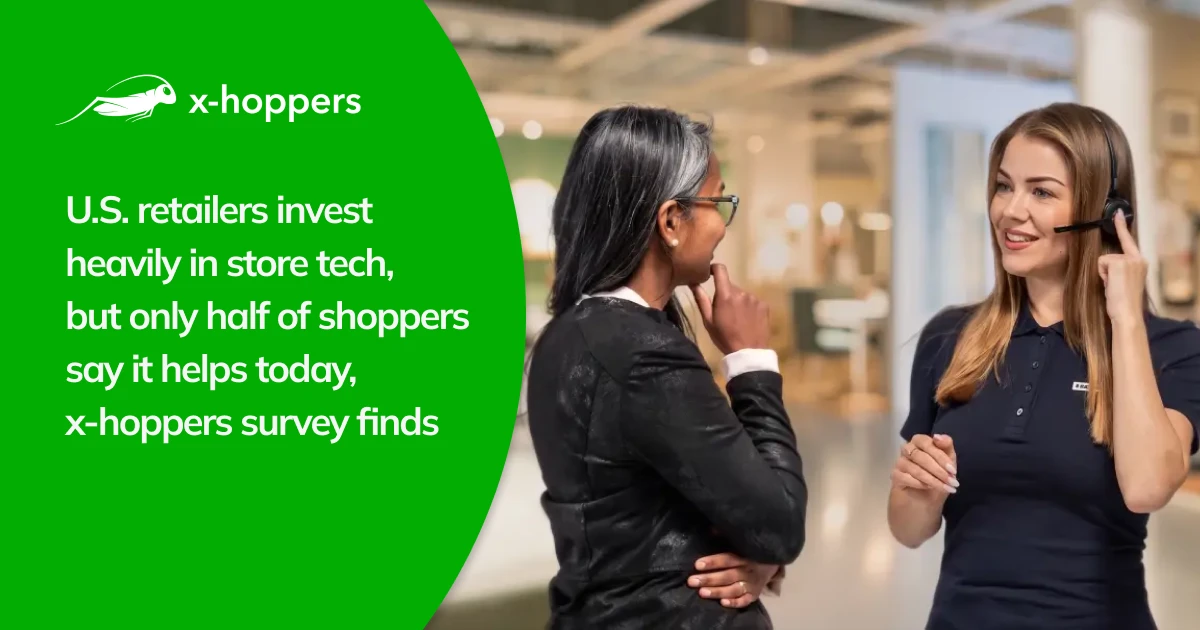
Shoppers say they want in‑store technology that makes life faster, easier and more connected, but only 44% of U.S. retailers have a formal connected‑store strategy, signaling a major opportunity for technology that truly links staff, systems and shoppers.
New research reveals a wide but opportunistic gap between technology investment and the experience customers actually desire.
That disconnect appears to start with strategy. According to the survey, 44% of U.S. retailers are operating without a formal connected-store strategy, even as they continue investing across customer-facing hardware, communications tools, store monitoring, AI, inventory systems and labor technologies. The result is often a store filled with technology, but not a store that feels easier, faster or more helpful in which to shop.
The gap between investment and execution shows up most clearly on the sales floor. Nearly eight in 10 retailers, 79%, admit associates must leave the customer’s side to use store systems, and only about one-third say notifications and information “almost always” reach the right person. When frontline teams have to walk away to check stock, find answers or fix systems, customers feel the delay immediately.
Consumers are clear about the consequences, as technology designed to reduce friction can backfire when it is poorly connected to staff workflows:
Yet the survey from x‑hoppers, the leader in AI‑powered communication for retail, suggests the real issue is not whether retailers are investing, but whether those investments are connected in ways that actually help staff serve customers faster and more consistently. The findings also point to what consumers actually want.
For retailers, that makes the connected store less a technology project than an execution challenge: connecting systems, people and information so service feels seamless in the moments that matter most.
There are signs retailers recognize that need. The survey found that 52% of U.S. retailers are already allocating up to 30% of their connected-store budget to frontline communication tools, and 47% say their top desired outcome is increasing conversion and sales. The opportunity now is to make sure those investments reduce friction for both associates and customers, instead of adding more complexity to the store environment.
These findings point to a simple conclusion: the primary in‑store challenge is not lack of technology, but the lack of a cohesive connected‑store approach that aligns systems, data and frontline communication. Retailers who bridge that gap can reduce operational friction, keep associates “eyes up” with customers and turn every interaction into an opportunity to strengthen loyalty.
In partnership with Sago, x‑hoppers commissioned a U.S. retail and consumer research study that took place in late April and early May 2026. The survey collected responses from 1,140 participants, including both retail decision-makers and consumers, to explore priorities, connected‑store strategies, and expectations in tech‑enabled stores. All responses were collected anonymously and are reported in aggregate.
x-hoppers is a smart retail communications solution with AI assistance, designed to improve store operations and customer experience. Powered by Wildix, a leading unified communications (UC) vendor with over 20 years of industry experience, x‑hoppers connects store associates to their in-store colleagues and the wider business through a combination of wireless headsets, a mobile app, smart call points and AI‑driven features. With over 500 integrations and powerful built‑in agentic AI, x‑hoppers provides all the tools retailers need to connect teams, train staff faster and serve customers smarter.