



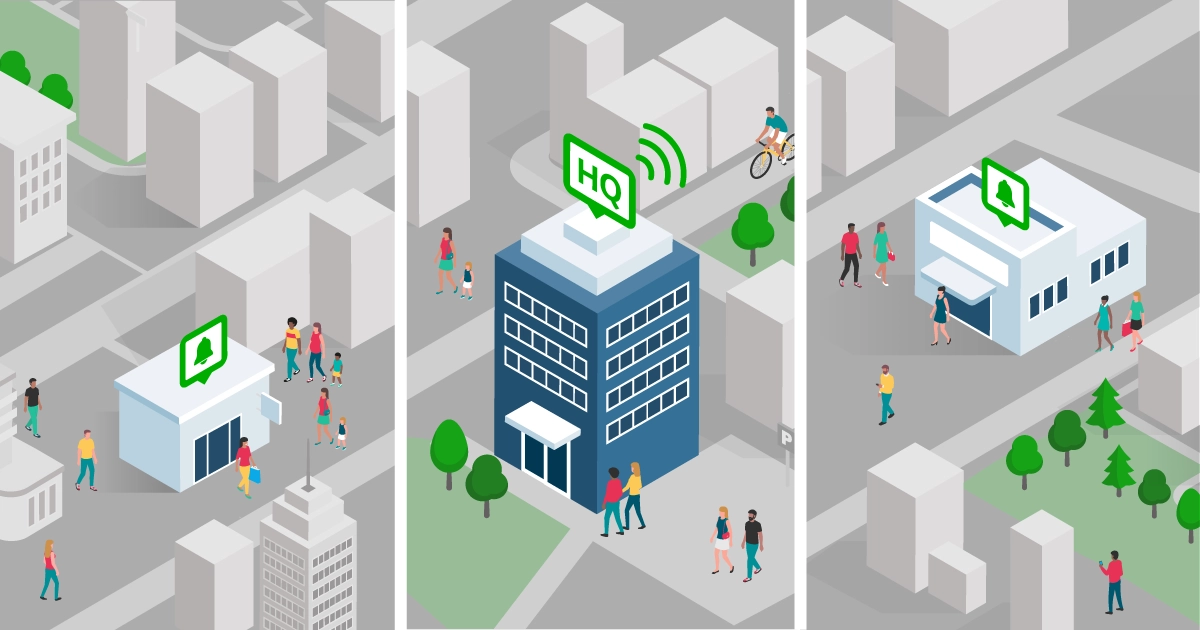
Running a single storefront is a massive balancing act. Trying to replicate that exact same magic across 10, 50 or 100 locations? That is a whole nother animal, especially when you introduce franchise partners who run their own daily operations into the mix.
But keeping things consistent is exactly what shoppers expect. In our The state of the connected store report 2026, we found that while a staggering 84% of American consumers (and 91% of British consumers) demand the same high-level experience regardless of which branch they visit, only a quarter of U.S. retailers actually manage to deliver it. This gap proves that brand consistency isn’t just a corporate metric — it directly drives customer satisfaction and, by extension, your bottom line.
So, how do you keep every store aligned? It all starts with communication. We are not talking about dusty handbooks or long-winded email chains that store managers occasionally ignore. To protect your brand standards, you need tools built for instant, multi-location communication.
Let’s take a look at the reasons why communication often breaks down, what a growing franchise actually needs to fix it and a step-by-step roadmap to get every one of your locations on the exact same page.
Why communication breaks down across multiple locations
When you are managing a single storefront, it is easy to call a team huddle and share an update. But as we explored in our guide on building your retail communication strategy, scaling that up creates certain roadblocks:
- Inconsistent tools across sites. One location is on a group chat app, another is still entirely dependent on store announcements and a third has a system nobody else has ever heard of. When every store solves communication its own way, head office has no reliable channel to reach everyone at once.
- Updates from headquarters that never reach the sales floor. Corporate announcements get buried in overflowing back-office email inboxes and updates are never actioned in store.
- Siloed shifts and departments. The morning shift knows about the new return policy. The evening shift doesn't. Loss prevention hears about a theft pattern; the sales floor doesn't. Every silo is a place where information gets trapped, hampering collaboration and consistent operations.
The franchisor-franchisee gap
For franchises, this problem has a unique element. Every brand standard, promotion, and operational tweak has to travel an incredibly long way, from corporate headquarters to the franchisee, then to the store manager and finally to the frontline associates. And every hop in that chain is a chance for the message to lose its focus.
By the time a new policy actually reaches the associate stocking shelves or greeting customers, it is often outdated, incomplete or completely misunderstood.
This is also where franchise management platforms and multi-store CRMs fall short. These tools do a solid job managing the corporate and franchisee relationship, contracts, royalties, reporting and the like, but they largely stop at the corporate layer. They aren’t built to get a message from a regional office into the ear of a part-time associate on a Saturday afternoon. And that’s exactly where execution actually lives or dies: on the sales floor, not in a dashboard.
What a multi-location setup actually needs
To fix this, a franchise network needs a communication platform that balances central control with local flexibility. You need a system that lets corporate push out critical, network-wide updates, like a sudden product recall or safety alert, while still giving individual stores their own quiet, private channels. After all, a team in Chicago doesn’t need to hear the daily shift-handover chatter of a store in Milwaukee.
We mapped out the evaluation criteria for exactly this trade-off in our guide on retail walkie-talkies vs. headset systems, and the rules apply just as much here. While a single-location boutique can easily get by with basic radios or a loudspeaker, a growing franchise simply cannot.
You need a scalable communication infrastructure that keeps its shape as you grow. That way, a crucial brand standard created at corporate headquarters lands intact in the headset of your newest hire, on their very first day, at your newest location.
Step-by-step: Setting up franchise communication that works
If you are ready to move away from a patchwork of mismatched walkie-talkies and unread emails, you need a plan. Setting up a streamlined system across multiple locations does not happen overnight, but you can smooth the transition by following this step‑by‑step roadmap:
- Audit the tools currently used at each location. You can't fix what you haven't mapped. Find out what every site is actually using day to day, not what they're supposed to be using.
- Map who needs to talk to whom. HQ to store, store to store and in-store team to team are three different conversations with three different urgency levels. Design for all three.
- Choose scalable, integration-ready infrastructure. Pick a platform built to grow with your franchise and connect to the tools you already rely on, not one you'll outgrow in a year.
- Roll out in phases, starting with a pilot location. Prove the model before asking the whole network to change how it works.
- Standardize alert priorities across the network. A safety alert and a marketing reminder should never look the same in anyone's inbox or on anyone's headset.
- Measure adoption and iterate. Check your data. See which locations are using the system effectively, identify where communication is lagging and use those insights to tweak your strategy.
Device-agnostic reality: one network, every role covered
Franchise teams are not one-device teams, and good multi-site communication systems shouldn’t pretend otherwise. An example we’ve seen work is a solution that uses DECT headsets for hands-free communication on the sales floor, paired with a mobile app for managers, regional teams and back-office staff, all running on one real-time network rather than a collection of disconnected apps or siloed communication hardware.
That’s the thinking behind the x‑hoppers mobile app, launched in January 2026 to extend communication beyond the headset. It lets regional managers join live store broadcasts and guide execution across locations without ever needing to physically be there, which matters a lot when your “there” is actually fifty different places at once.
Retailers running multi-location operations are already putting it to work. Hassett Ace Hardware’s leadership team uses it to stay connected to live store conversations and view AI transcriptions in real time. Heron Foods relies on it to stay connected to live conversations and jump in instantly from a phone. And Orfa & Co uses it to communicate directly and in real time with teams across every location, keeping everyone aligned on brand updates without adding new hardware.
That’s really the point: the headset is essential in store and the mobile app extends the same live network to everyone who is off‑site.
Your corporate team sits at desks, your regional managers live in their cars and your frontline staff members are on their feet serving customers. Forcing them onto the same hardware ignores the reality of how franchised stores work.
Cross-location visibility for leadership
Once every location is on the same network, leadership finally gets something franchise operators rarely have: real visibility without needing to be on site.
That includes:
- Real-time AI transcriptions in team chats, making it easy for managers to spot issues or training gaps instantly.
- Targeted alerts sent to employees in certain departments or with certain skills, so a first aider update only goes out to trained employees while an update on targets reaches managers without interrupting the sales floor.
- Remote monitoring of store activity from any connected device, which means a regional manager can check in on three stores before their coffee's finished brewing.
This kind of visibility connects directly back to the customer experience too. When staff have access to effective in‑store communication, service gets faster and more consistent, which encourages repeat visits and sales.
The cost angle for franchises
Expanding your tech stack shouldn’t blow your budget. For franchise operators, smart franchise communication software actually drives down costs in two major ways:
Lower hardware spend
By embracing a bring-your-own-device (BYOD) model for non-frontline roles, your managers, assistant managers and regional teams can use their existing smartphones. You only buy headsets for the staff who truly need them in‑store, cutting down your upfront hardware investment.
Faster onboarding times
High turnover is a reality in retail, and training new hires across dozens of franchise locations is expensive and takes months. With built‑in AI assistance, new employees can ask their headsets directly about store policies, stock locations or procedures. This on‑demand support has been shown to cut employee training time by up to 50%, saving countless hours of manager supervision.
A decision checklist for franchise operators
If you’re evaluating platforms for your network, run each option through this checklist:
- Scalability. Can the system easily add new users, teams and physical storefronts as your business grows?
- Central oversight with local flexibility. Can you push network-wide broadcasts while giving individual stores their own private communication channels?
- Open integrations. Does the platform connect with your existing tech, like your POS, task management systems and security tools?
- Security and compliance. Does the software meet enterprise data security standards to protect your internal business communication?
- Total ROI. Look beyond the price of the headsets. Does the system deliver long-term financial value through reduced training times, lower hardware costs and better task compliance?
Franchise communication isn’t about picking the flashiest tool, it’s about picking the one that works as a franchise communication hub, keeping every location, every shift and every device on the same page. If you want to see what that looks like in practice, take a look at the full retail communication solution from x‑hoppers.
x-hoppers: Connecting your entire business
We designed our platform to bridge the exact gaps that keep franchise operators up at night. Here is why x‑hoppers is the perfect fit for your growing network:
- A unified lifeline from headquarters to the shop floor: No more lost emails or filtered messages. When you need to push a critical update, you can broadcast it directly to the headsets of frontline teams across your entire estate instantly.
- A portable command center for regional leadership: With the x‑hoppers mobile app, area managers can jump into live store channels, review AI-generated transcriptions and keep a pulse on operations without spending their entire week on the highway.
- Day-one confidence for new hires: High turnover is tough on business consistency. By giving seasonal staff and new hires an on‑demand AI assistant right in their ear, you can cut training times by 50% and keep customer service seamless, even on a busy weekend.
- Frictionless integrations with your existing tech: We connect with your current task management, POS and security systems. This turns your headsets into active workflow tools that receive and update tasks hands‑free.
At the end of the day, a franchise is only as strong as its weakest link. When you break down the communication barriers between your corporate office, your regional managers and your frontline associates, you do not just make life easier for your team — you secure the consistent, high-quality experience that keeps your customers coming back to shop with your brand every single time.
Ready to upgrade your franchise network’s communication? Speak to a member of our team today to discover how our smart retail communications solution can help you improve operations and boost efficiency across every store.