



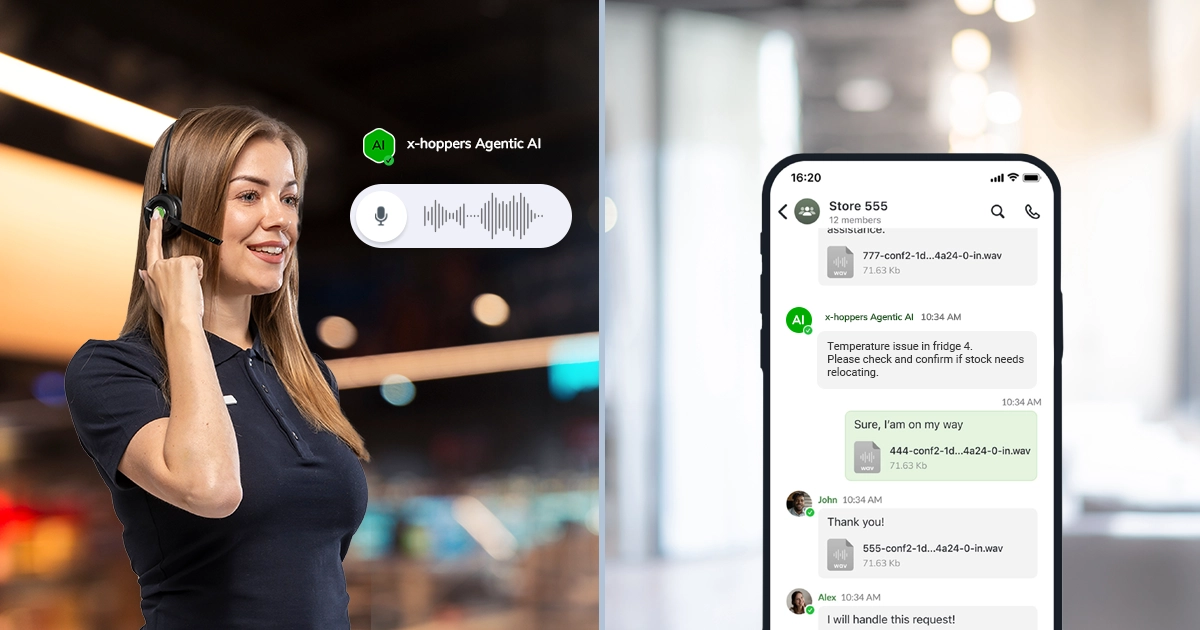
Let’s start by imagining a common in‑store scenario. A customer comes up to a new employee who’s just started their second shift and asks for help making a return. The employee quickly realizes it’s a complex return, but knows that the store manager is tied up with a delivery and isn’t on hand to help. Instead of making the customer wait or fumbling through a procedure manual, the associate simply presses a button and asks their headset, “How do I process a return for a damaged item?” Instantly, they receive step-by-step guidance and just five seconds later, they’re confidently handling the transaction.
This isn’t science fiction. It’s a practical application of conversational AI in retail, and it’s fundamentally changing how stores operate, how employees work and how customers experience service. While AI, particularly the machine learning variety, is no stranger to retail, conversational AI is a practical and immediately useful technology as it understands natural language and provides instant, accurate assistance exactly when people need it.
Curious? Let’s take a closer look at what conversational AI actually means for retail operations, how it works, what benefits it delivers and why forward-thinking retailers are implementing these systems now to stay competitive and future-proof their stores.
What is conversational AI and how does it work?
Conversational AI refers to technology that enables machines to understand, process and respond to human language in natural, contextual ways. Unlike rigid automated systems that require specific commands or menu navigation, conversational AI interprets what people actually mean rather than just what they literally say.
The technology combines several sophisticated capabilities working together seamlessly.
- Natural language processing (NLP) enables systems to understand human speech or text input, including variations in phrasing, context and intent.
- Machine learning allows these systems to improve over time by learning from interactions and expanding their knowledge base.
- Voice recognition technology converts spoken words into text that can be processed, while text-to-speech capabilities allow an AI interface to offer spoken responses.
For retail applications, conversational AI creates intelligent AI assistants that employees and customers can interact with naturally. Instead of navigating complex software interfaces or searching through documentation, users simply ask questions conversationally and receive immediate, relevant answers.
Voice vs. text: Choosing the right tool for the sales floor
There are two main ways users can engage with conversational AI for retail, and they each fit different situations and use cases.
Voice assistants
Voice-based AI retail solutions allow associates to interact with AI assistants and store systems hands-free through the power of voice alone. For example, employees can request information or issue commands while continuing other tasks, including serving customers, stocking shelves or handling merchandise. This is especially valuable for in‑store associates since they are constantly mobile and need access to information that doesn’t interrupt their workflow.
In-store applications
With conversational AI, retail associates can:
- Get answers to procedural questions
- Check stock levels
- Accept system notifications
- Handle calls (depending on the solution’s telephony support)
- Acknowledge, update and create tasks, whether through an integrated task management or helpdesk ticketing system
• Get answers to procedural questions
• Check stock levels
• Accept system notifications
• Handle calls (depending on the solution’s telephony support)
• Acknowledge, update and create tasks, whether through an integrated task management or helpdesk ticketing system
Benefits
When delivered through a wearable device, such as a hands-free headset, associates experience:
- Instant access to information while assisting customers
- Reduced device switching
- Faster task coordination
- Improved situational awareness
Text or chat assistants
Text-based AI retail solutions depend on typed interactions on screens, tablets or mobile devices. These work better for situations that require visual confirmation, complex multi-step processes or detailed information display that benefits from reading rather than listening.
Applications
Most commonly used in customer-facing solutions, text-based conversational AI’s applications include:
- Customer service AI chatbots on retail websites and apps
- Assistance for back-office employees working with reports, analytics, scheduling or planning tools
- Support for frontline workers who are deaf or hard of hearing
Benefits
- Structured interactions
- Easy integration with e‑commerce platforms
- Ideal for customer FAQs and digital support
- Increased accessibility
So what’s the best solution? Well, it depends on your setup, but generally, the most effective conversational AI solutions combine both and allow users to interact through whichever method suits their needs. For example, the same employee might use voice commands on the sales floor but switch to text-based AI when they’re reviewing detailed reports in the back office.
Real-world applications: Putting conversational AI to work
When you put a voice-powered AI assistant retail solution on the shop floor, you can solve some of your biggest operational headaches.
1. Inventory management
Instead of leaving a customer to check a terminal or dig through the stockroom, associates can simply ask, “How many blue shirts in medium?” and get an instant, hands-free answer. This gives them immediate visibility into stock levels, transfers and alternatives, turning a potential lost sale into a confident customer interaction.
2. Employee training and knowledge access
The “Forgetting Curve” is real. New hires can’t possibly remember every procedure from a one-time training session. Retail AI chatbots and voice assistant acts as a 24/7 expert resource that they can query for anything, from return policies to compliance rules. This transforms training from a disruptive event into a continuous, on‑demand process that builds confidence on every shift.
3. Customer service
Instead of making a customer wait while they search for an answer, an associate can discreetly ask their conversational AI assistant and get an accurate response in seconds. Whether it’s a complex product question, a price check or warranty details, associates are transformed from information-seekers into instant experts, building customer trust and closing sales faster.
4. Task coordination
Instead of managers manually assigning tasks and chasing down updates, conversational AI, combined with agentic AI, can coordinate it all automatically. In this scenario, the system delivers audio reminders for everything from opening procedures to compliance checks. Once a task is done, the associate confirms it with their voice and the system moves to the next priority. Additionally, associates and managers can create tasks simply by speaking to the AI assistant or even receive tasks the AI has created itself, based on system integrations and conversational input. This application frees up your managers so they can spend less time chasing tasks and more time coaching and leading their team.
Integration with existing retail systems
Conversational AI, delivered through a communication solution, like x‑hoppers, is designed to seamlessly connect with the tools you rely on every day. It acts as a unifying intelligence layer that makes the systems you already own work smarter together. This includes:
- Point-of-Sale (POS) platforms
- Inventory and supply chain systems
- Task and employee management software
- Security, computer vision and IoT sensor systems
- CRM and business intelligence platforms
This deep integration transforms siloed data into real-time action. When an associate asks about product availability, the AI pulls the information from your inventory system instantly. When a customer needs assistance on a self-checkout, the AI sends a hands-free alert directly to the right associate. The end result? It turns your entire tech stack into a responsive, interconnected ecosystem, creating a truly connected store.
Reducing response times from hours to seconds
One of the most dramatic impacts of conversational AI involves reducing the time spent searching for answers. In a traditional setup, finding information requires an associate to stop what they’re doing, find a manager or a computer terminal, navigate systems or documentation and then return to their original task.
This process consumes minutes or even hours, if a manager is unavailable or systems are down. Multiply these delays across the dozens of queries each employee handles a day and the productivity loss is substantial.
Conversational AI reduces this cycle to seconds. With this technology:
- Questions are answered instantly
- Context is preserved
- Tasks are assigned automatically
- Escalations happen in real time
For example, an x‑hoppers customer, Orfa & Co, was able to leverage conversational AI to save up to 45 hours per week, proving that it has real measurable impact on in‑store operations.
The bottom line: Measuring the ROI of conversational AI
However, time savings is only one of the measurable benefits of employing conversational AI in retail. Additionally, retailers who use the technology have seen:
- Error reduction thanks to instant access to correct procedures for everything from promotions to safety compliance.
- Faster training and onboarding powered by instant, hands-free access to information. This faster on-the-floor training not only reduces onboarding and labor costs, it also frees up managers and other professionals to focus on higher-value tasks. For example, an x‑hoppers customer reduced calls to their IT helpdesk by 40% simply by using an AI assistant for Tier 0 support.
- Improved employee satisfaction. With access to the right tools for the job, employees feel supported, causing turnover to decrease and performance to increase.
Getting started: Your implementation roadmap
Adopting conversational AI doesn’t have to be a massive overhaul. A successful implementation typically follows a clear path that minimizes disruption while maximizing value.
1. Map your challenges.
Before you do anything, pinpoint your biggest operational headaches. Where do your teams waste the most time? What questions do they ask constantly? Establish your baseline metrics at this stage so you can measure the massive improvement to come.
2. Prove the value.
Next, launch a controlled pilot in one or two locations. Focus on solving one or two high-impact problems, such as cutting down on manager interruptions or response times. By measuring the results against your baseline, you’ll build internal champions and a bulletproof business case.
3. Scale with confidence.
With a successful pilot, you have the blueprint to expand. Roll out the solution to additional locations, leveraging your experienced pilot team to mentor new users. This is where you focus on change management and company-wide training to ensure a smooth, successful deployment.
4. Unlock new value.
Your initial deployment is just the beginning. The final step is continuous optimization. Use the platform’s analytics to discover new use cases, expand integrations with other systems and ensure your conversational AI assistant gets smarter and more valuable with each passing month.
Security and privacy considerations
In retail, trust is everything. That’s why a true enterprise-grade conversational AI platform should treat security and privacy as its foundation, not as an afterthought. Protecting your business, your employees and your customers is non‑negotiable.
A secure platform should always deliver:
- End-to-end encryption. All voice and text data must be fully encrypted, both in transit and at rest, protecting it from unauthorized access.
- Role-based access controls. The right information should only go to the right people. A robust system allows you to set different permission levels for store associates, managers and corporate users.
- Comprehensive audit trails. Every interaction with the AI should be logged, providing a clear, searchable record for compliance and security reviews.
- Customer data privacy. Any customer information must be handled with strict confidentiality, in line with all relevant data protection regulations like GDPR and CCPA.
When evaluating any AI solution, don’t just ask about features — explore its security architecture. Look for vendor certifications, ask tough questions about data handling and demand a platform that proves its commitment to protecting your business.
The future of conversational AI in retail
Conversational AI is already a game-changer, but its evolution is just getting started. The technology is rapidly moving beyond simple Q&A to become the central nervous system of the truly intelligent store. Here’s where it’s headed next:
Multimodal interactions
Conversational AI assistants will move beyond just voice, using visual data from cameras to understand context and displaying information on screens to provide richer, more intuitive assistance.
Predictive, proactive support
Instead of waiting to be asked, the AI will analyze store patterns to anticipate needs, proactively feeding associates the information they need to close a sale or solve a problem before it happens.
Autonomous workflow orchestration
The AI will become the central hub for your automated systems, coordinating tasks between bots, sensors and your human team for maximum efficiency.
Personalized, adaptive learning
The system will learn from every interaction, tailoring its responses to each user’s role and becoming a progressively smarter and more valuable partner on every shift.
While this future is exciting, the most powerful advantage comes from empowering the people you have today. By connecting your team to an intelligent, voice-first platform, you create a more responsive and efficient retail environment, building the foundation for the autonomous store of tomorrow.
How to bring conversational AI to your sales floor
So, how do you bring a powerful conversational AI retail solution into your stores without adding complexity? The answer isn’t to deploy it as a separate system. It’s to deploy it embedded in a smart communications solution, creating an intuitive interface between your associates, information and systems.
That’s the core of the x‑hoppers platform. We deliver powerful, voice-first conversational AI through the same x‑hoppers headset used for instant, hands-free communication, offering one seamless experience. Associates can ask the AI for a stock check, then immediately ask a human colleague for help with a customer, all on the same device.
And for managers, we also offer a mobile app which gives them the same access to our conversational AI and push-to-talk capabilities, but also keeps them in the loop with what’s happening on the shop floor through real-time transcriptions of broadcasts and smart notifications and text-to-speech messaging, even when they’re not in the store.
This fusion of communication and intelligence eliminates the false choice between efficiency and service. It transforms managers from human search engines into on-the-floor leaders and empowers your associates to solve problems instantly.
Ready to stop managing chaos and start orchestrating success? Speak to a member of our team to see how x‑hoppers can help you connect your teams, train them faster and serve your customers smarter.
Frequently asked questions
What is conversational AI in retail?
Conversational AI in retail refers to AI systems that enable natural language processing (NLP) and machine learning to understand and respond to human language. This includes interactions between employees and/or customers using voice or text, helping to automate tasks, provide information and improve communication.
How does conversational AI differ from traditional chatbots in retail?
While a retail AI chatbot is a form of conversational AI, it is typically text-based and used for online customer service. Advanced conversational AI, especially voice-based platforms, is used inside the store by employees for hands-free operational tasks, instant access to information and communication.
What are the main use cases for conversational AI in retail stores?
The main use cases include on-demand employee training, hands-free task management, instant internal and external communication (including call handling), inventory queries and providing store associates with the information they need to deliver faster, more accurate customer service.
What ROI can retailers expect from implementing conversational AI?
Retailers can expect a significant ROI through reduced employee training costs, increased operational efficiency, fewer costly errors due to incorrect procedures and higher sales from improved customer service and reduced wait times.
Is conversational AI difficult to implement in existing retail operations?
No. Modern conversational AI platforms are designed to be user-friendly and integrate with existing systems like POS and task management solutions. Implementation is typically done through a phased approach, starting with a pilot program to ensure a smooth rollout.