



If you’ve been following tech trends lately, you’ve probably noticed that wearable technology is everywhere. Just last year the global wearable technology market was valued at $78.40 billion and it’s projected to grow to $191.58 billion by 2032, driven by everything from smartwatches to augmented reality glasses.
But here’s what’s interesting: while most people think of wearables as consumer gadgets for tracking steps or checking notifications, there’s a whole other side of wearable technology that’s transforming how businesses run.
In retail, wearable technology is quietly revolutionizing how frontline teams communicate with each other and with customers. It’s speeding up responses, improving service and giving staff the freedom to focus on what really matters: the customer experience.
Curious? Let’s dive into the world of wearables to see how they are solving real problems for retail teams now and where the technology is headed next.
What is wearable communication technology for retail?
In simple terms, wearable technology in retail refers to devices that employees can wear and access throughout their shifts. While wearable computers and scanner rings are classified as wearables, the most common devices are ones that enhance communication and give associates access to information without having to slow down or lose focus.
Unlike traditional handsets, radios or tablet-based solutions, these devices are designed for movement. Associates don’t have to juggle them, clip them to belts or pause conversations to look at a screen. Because let’s be honest, even the best belt clip eventually breaks, and carrying a handset or radio around all day is asking for it to be lost or broken. And while tablets have their place, they draw attention away from customers and can cause staff to miss vital buying signals.
Wearables change that. Designed for the realities of retail that include constant movement, background noise and teamwork under pressure, they make it possible for staff to communicate clearly, instantly and completely hands-free from anywhere in store.
Why is wearable communication important for retail stores?
It may be cliché, but retail moves fast, and stores can’t afford to slow down because of poor communication. Associates need to collaborate across departments and even entire store networks to keep service smooth and operations running efficiently.
Tools like radios, phones and PA systems simply can’t keep up. When staff have to leave the shop floor to find a colleague or answer a call, customers are left waiting, and opportunities are lost. Wearable communication fixes that by keeping everyone connected, no matter where they are in the store.
It’s especially vital in today’s lean retail environment, where smaller teams cover more ground than ever. With wearables, every associate has instant access to their team’s collective knowledge, helping them handle customer requests, coordinate deliveries or solve problems on the spot.
And as stores continue to blend in-person and online experiences, from buy online, pick up in store (BOPIS) to digital inventory checks, communication needs to be instant, intuitive and hands-free. Wearable technology delivers exactly that, turning retail teams into one connected, responsive unit ready for whatever comes next.
How retail communication systems work: From radios to DECT headsets
First, let’s cover the different options for wireless team communication. The oldest is radio. There are versions of wireless retail headsets that use radio to connect teams, but they are clunky, one-way and often unreliable. Most radio-based headsets don’t support full-duplex communication, which means only one person can speak at a time. That might work on a construction site, but not in a busy store where teams need fluid, natural conversation.
The second widely used solution is WiFi. This is how wearable computers power communication apps and is also the underlying technology behind Bluetooth earphones or other devices, as they need to connect to a tablet or smartphone to work.
The third, and most reliable wireless communication technology, is DECT (Digital Enhanced Cordless Telecommunications). DECT headsets for retail operate on dedicated frequencies that don’t compete with WiFi networks or other wireless devices, providing reliable, crystal-clear audio across the entire store without the need to connect to any other devices. Retail headset systems based on DECT can offer both a broadcast option where everyone can hear what is said on one channel or even facilitate one‑to-one calls, making them truly flexible for diverse retail communication needs.
This means associates can connect with everyone on shift in real time, allowing for instant coordination between the sales floor, stockroom, checkout and management. And when a customer asks about product availability, an associate can quietly check with colleagues without ever leaving the customer’s side or breaking eye contact to stare at a screen.
But the real power comes when this technology connects with other store systems. Modern retail communication platforms, like x‑hoppers, combine DECT with AI‑driven tools that let associates not only talk to colleagues, but also:
- Access product and stock information instantly through simple voice commands
- Receive automated alerts from smart shelves or IoT sensors
- Get on-the-job support with training, troubleshooting and procedural guidance
As a result, wearables don’t just connect people — they can connect your entire store.
Types of wearable communication devices
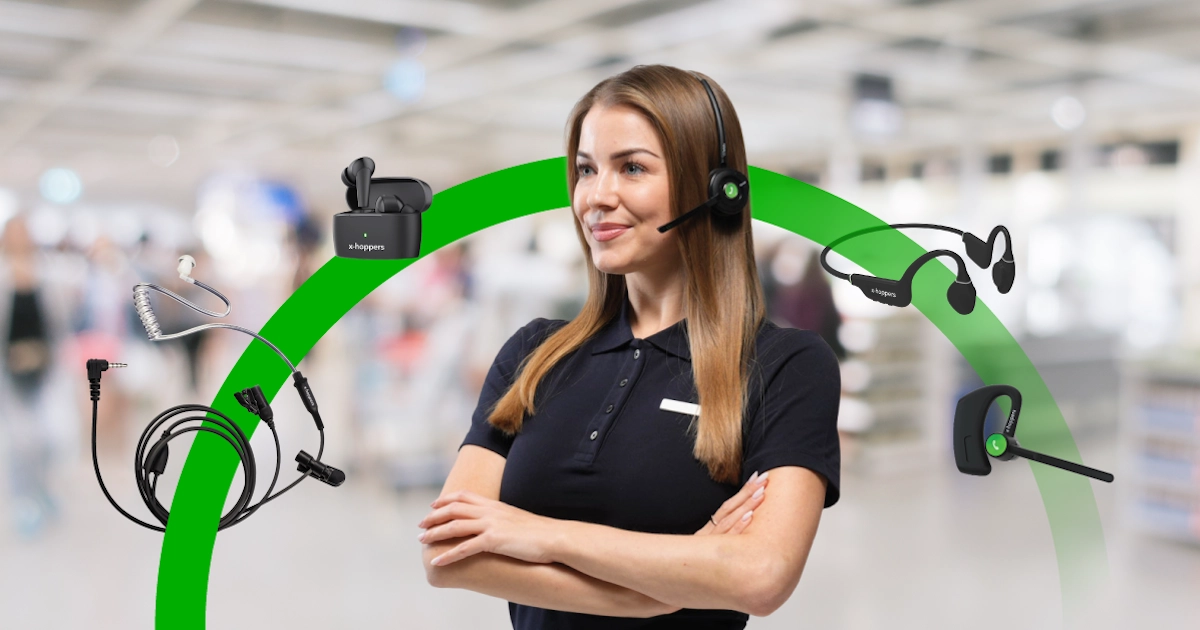
Retailers now have more ways than ever to keep their teams connected. Some of the most common types of wearable communication devices include:
- Wireless retail headsets: Lightweight, comfortable and perfect for team‑to-team coordination across departments.
- Smart badges and clip‑on communicators: Quick push‑to-talk devices ideal for fast, simple communication.
- Voice-enabled wrist devices: Great for warehouse, picking or inventory management tasks that require mobility.
- AI-powered headsets: Combine hands‑free communication with voice‑activated calling, instant knowledge access and real‑time analytics.
Each device brings unique strengths, but together, they represent a shift toward truly connected store ecosystems where communication, data and action all flow seamlessly.
How is wearable communication different from walkie‑talkies?
While walkie-talkies may provide basic wireless communication, wearable communication systems take everything they do and make it faster, clearer and more discreet.
Here’s how they compare:
- Full-duplex communication: Wearable headsets allow everyone to talk and listen at the same time, just like a phone call. No waiting for someone to finish talking.
- Crystal-clear sound: DECT‑powered devices eliminate the static and interruptions that plague walkie‑talkies.
- Hands-free operation: Associates can keep both hands free to help customers, restock or handle tasks, all while staying connected.
- Discreet conversations: Messages are played directly into an earpiece, so customers don't hear internal chatter or storewide pages.
- Smart integrations: Modern retail headset systems can link with store technologies like smart call points, smart shelves and AI assistants, while walkie‑talkies can't.
- Reliable coverage: DECT systems deliver consistent communication across the entire store footprint with no dead zones or dropped signals.
In short, wearable communication doesn’t just replace walkie‑talkies — it reinvents how teams connect.
And when combined with AI and real‑time integrations, retail team communication systems like x‑hoppers transform that connection into action, helping teams serve customers faster, train on the floor and keep operations running smoothly.
What are the benefits of wearable communication in retail?
The benefits go far beyond simply staying in touch. Wearable communication is transforming how retail teams work, making stores faster, smarter and more connected than ever. In fact, it offers:
- Elevated customer service: Associates can get answers and assistance without leaving a customer waiting or disappearing into the stockroom, keeping customers engaged and improving satisfaction on the spot.
- Lighting-fast response times: Whether it's restocking, handling a spill or responding to a smart call point, connected teams can act immediately. Small issues stay small, and big ones get solved before they impact the in‑store experience.
- Productivity gains: When associates don't have to chase down colleagues or switch between devices, they can stay focused on what matters: serving customers. Over time, that efficiency translates into smoother operations and higher sales.
- Safety and security: With wearable headsets, staff can discreetly ask for backup, notify managers of potential issues or even receive alerts from security systems, creating a safer, more supported work environment.
- Faster onboarding: New hires can learn on the shop floor, asking questions and getting answers in real time from both teammates and AI assistants. This way, training becomes part of the workflow and not a separate task.
In short, wearable communication makes the entire store ecosystem stronger. It connects people, systems and information in real time, turning everyday moments into opportunities to deliver better service, stronger teamwork and consistent results.
The future of wearable communication in retail
Wearable communication is evolving, and the “smartest” solutions will come out on top.
AI is already turning wireless retail headsets from simple communication tools into intelligent assistants. Advanced systems like x‑hoppers use agentic and generative AI to answer questions, share product info and even flag unusual activity, helping teams stay one step ahead.
As these capabilities grow, we’ll see wearables that can automate tasks, predict needs and even translate conversations in real time, connecting diverse teams and customers seamlessly.
Integration is another big leap forward. Wearables are becoming the central hub for everything in store, linking staff to inventory systems, sensors, POS data and even CRM tools. New integrations will continue to emerge, creating more automated workflows that allow associates to focus more on the customer experience and less on mundane tasks.
The direction is clear: retail is heading toward fully connected, intelligent stores where every associate has real-time information, instant collaboration and AI support all through a single wearable device.
And the best part is, it isn’t science fiction — it’s happening right now.
x-hoppers: Creating truly connected stores
At x-hoppers, we’ve built the next generation of wearable communication for retail with our smart retail headset system that unites people, data and technology in one seamless network.
Offering a unique combination of full-duplex DECT communication, voice-activated telephony and real‑time analytics, x‑hoppers helps teams:
- Connect instantly with colleagues, headquarters and customers.
- Train faster with instant access to colleagues, built‑in AI guidance and on‑the‑floor learning.
- Serve smarter with instant alerts, notifications and customer call points.
- Stay future-ready with open APIs and integrations that grow with your tech stack.
So if you’re ready to connect your people, processes and technology, let’s build the store of the future — together.
Because the smartest stores aren’t automated, they’re human, connected and ready for whatever comes next.
Ready to see how? Speak to our team to discover how x‑hoppers can transform your business.