



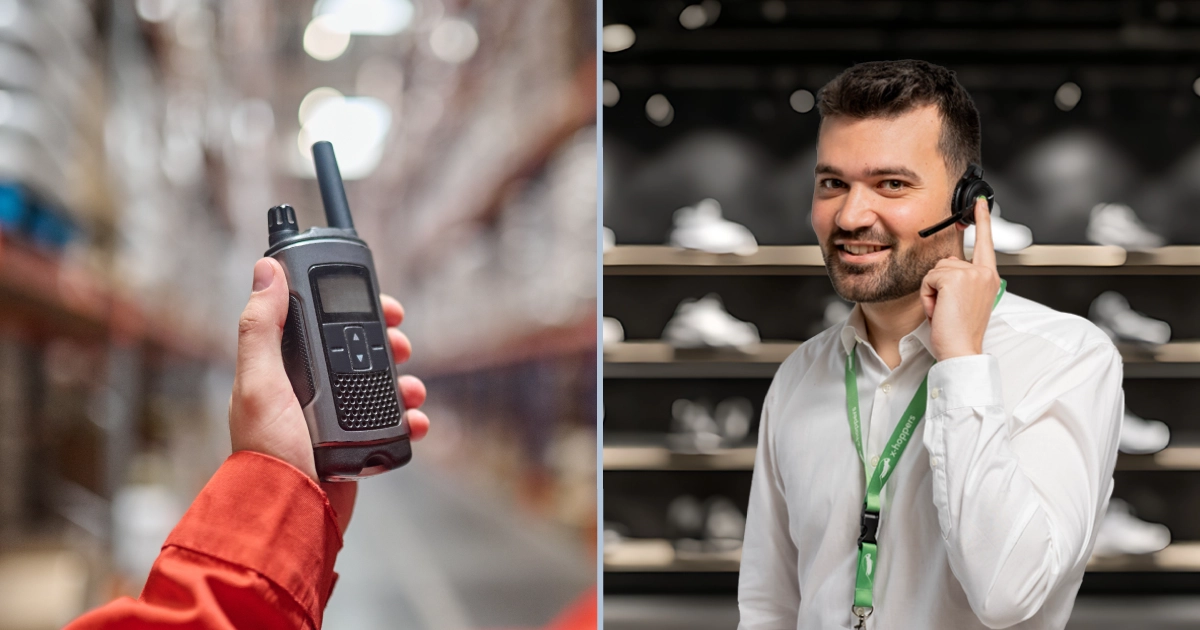
Chances are, if you walk into a store today, you’ll still spot a familiar sight: the trusty walkie‑talkie.
While they’re not the only type of store communication solution, bulky, static-filled walkie-talkies clipped to belts have long been the norm, with their loud store chatter simply accepted as part of retail life. But here’s the thing: while retail walkie-talkies have been the communication workhorse for decades, they’re starting to show their age in today’s fast-paced retail environment.
Don’t get us wrong. Walkie-talkies served us well for years. They got the job done when the alternatives were literally running across the store to find someone, shouting over a PA system or using landline phones tethered to the wall. But just as we’ve moved past flip phones and dial-up internet, it’s time to take a fresh look at whether traditional two-way radios built for retail are really the best solution for modern store operations.
Let’s explore what retail walkie-talkies actually are, why they became so popular, and most importantly, what’s evolved beyond them to create truly connected store environments.
What are walkie‑talkies? Understanding the basics
Walkie-talkies, also known as two-way radios, are handheld devices that allow users to communicate over the same radio frequency. The concept is beautifully simple: press a button, speak into the device, release the button and wait for a response. This push-to-talk (PTT) system has been around since World War II and found its way into retail in the 1970s and 1980s.
Common terms:
- PTT: Push-to-talk
- Channels: Different communication frequencies
- GMRS / FRS: Common radio frequency bands that stand for General Mobile Radio Service and Family Radio Service
- Range: How far a signal can travel
They’ve been used in retail for:
- Stockroom coordination
- Locating colleagues
- Calling for customer assistance
- Security alerts
- Basic store-to-store coordination
Why? The appeal is obvious. Unlike phone calls which require finding a landline or using expensive cell phone minutes, walkie-talkies provide instant communication with zero per-use costs. The mobility they offer was revolutionary at a time when the alternative was to be tethered to desk phones. For retailers operating on thin margins, the value proposition of one-time hardware purchases with no ongoing service fees was — and is still — compelling.
But it is a stagnant technology.
The evolution beyond traditional walkie‑talkies
Retail, on the other hand, is constantly changing and evolving. Today’s customers expect seamless omnichannel experiences, instant information access and service that feels personalized rather than transactional. Store tech stacks have also expanded, creating a need to connect systems rather than rely on single-purpose communication devices. Now, retailers need more than a scratchy voice on a shared channel — they need connected, smart retail communication systems that work with the rest of their operations.
Even walkie-talkies designed for retail stores can’t keep up because they:
- Only allow one-way communication (no full-duplex conversations)
- Don't integrate with POS, inventory systems or security tech
- Provide no data or analytics
- Can't deliver AI‑powered automation
- Aren't hands-free
- Make customer conversations awkward
- Don't support remote teams or multi-location management
And while walkie-talkies still “work,” the gap between what they offer and what modern stores actually need keeps getting wider, putting extra pressure on retail teams every single day.
Real challenges with traditional walkie‑talkies in retail
How does that pressure manifest? Let’s take a quick look at what associates really deal with when they rely on old‑school two‑way radios:
- Radio interference and channel congestion
Crowded channels create confusion. Add to it constant background static and its no wonder that so many important messages slip through the cracks.
- No tech integration
Walkie-talkies live in their own world. They can’t talk to your POS, inventory tools or security systems, which means no automatic alerts, no smart routing and no way to connect your retail team communication to the rest of your operations. The result? Slower workflows and unnecessary gaps in store coordination.
- Dead zones and range limitations
Ever tried using a walkie-talkie and been met with silence? Unfortunately, dead spots are a reality, especially in large retail spaces. Metal shelving and thick walls wreak havoc on radio signals, leaving teams wondering if their colleagues have disappeared or just gone to aisle 12.
- No analytics or visibility
With walkie-talkies, you’re basically running your store with the lights off. There’s no way to see how teams are actually communicating, where things slow down or what keeps tripping people up. It’s all guesswork — and guesswork doesn’t scale.
What you can’t track:
- Response times
- Common questions
- Workflow bottlenecks
- Training needs
- Performance insights
- High friction for training and usage
Walkie-talkies add friction from day one. New hires have to learn channels, codes and battery quirks before they’ve even learned the shop layout. Meanwhile, managers end up juggling dead devices and missing radios. Generally, instead of speeding things up, they slow everyone down.
- Open-channel security concerns
With walkie-talkies, anyone in range or using a scanner can hear what’s said, including things that should never leave the team. Sensitive updates, security issues or staff conversations can easily spill into the open, creating risks no retailer can afford.
What modern retail communication needs
Today’s stores need modern communication solutions that do far more than transmit a voice. They need systems that keep teams connected, informed and ready to act.
Here’s what actually makes a difference on the shop floor:
- Hands-free operation
Associates should never have to stop what they’re doing to connect with their team. Staying connected while staying present with customers is essential.
- AI + automation
From low-stock alerts to troubleshooting, automated notifications and AI workflows help teams act before small issues turn into big ones.
- Real-time alerts
Whether it’s a customer at the self-checkouts, a malfunctioning fridge or a delivery, store teams need to know the moment something needs attention.
Visibility into response times, common questions and communication patterns helps managers coach smarter and improve performance.
- Scalability
As your store network grows, your communication shouldn’t fall behind. Cloud scalability ensures every team gets the same clarity, updates and support, no matter where they’re located.
Communication shouldn’t sit on an island. It should integrate with POS, inventory, task management and security tools to create a seamless workflow.
This is the baseline for modern retail. And walkie-talkies simply can’t meet these requirements.
Smart alternatives to traditional walkie‑talkies
Modern retailers aren’t just swapping out walkie-talkies; they’re upgrading to complete retail communication solutions built for today’s stores. These unified communication platforms do everything radios can’t, giving teams clearer communication, faster support and instant access to the information they need.
Here’s what the new generation of in‑store communication looks like:
- Wireless, hands-free headsets (DECT)
Lightweight, comfortable and crystal-clear with full-duplex conversations so multiple people can talk and listen naturally, just like a real call.
- Built-in telephony and smart routing
Internal calls, external calls and automated alerts all come through on one device, ensuring the right person gets the right message the first time.
- AI-powered assistance
Instant answers on products, pricing, stock, procedures and troubleshooting, giving associates on‑demand knowledge without ever leaving the shop floor.
- QR-code-based smart call points for customer requests
Customers scan, you respond. Alerts automatically route to the best-placed team member based on role.
- Cloud-based communications
Updates roll out automatically across every store and the in‑store and office teams can communicate seamlessly across different devices.
- Integrations with your retail tech stack
Thanks to ready-to-go integrations and open APIs, modern communications solutions can connect to any number of systems and devices, sending alerts whenever needed, so the right team member gets notified instantly.
These solutions don’t just replace radios; they transform how teams communicate, collaborate and serve. It’s the leap retail has been waiting for.
ROI: Beyond basic communication
Upgrading from traditional walkie-talkies isn’t just about clearer audio — it’s about unlocking real, measurable value across your entire store operation. Modern retail communication systems turn every interaction into an opportunity to improve service, speed and efficiency.
Here’s what retailers see when they make the switch:
- Increased sales thanks to faster, more responsive customer service
- Faster onboarding, with new hires learning on the floor through real‑time support
- Fewer errors and returns because associates get instant, accurate answers anywhere
- Higher staff satisfaction and retention, driven by increased confidence and reduced stress
- Fewer IT tickets, with voice-guided troubleshooting resolving issues before they escalate
- Multi-functional value, combining communication, training and analytics into one system
In essence, walkie-talkies are an expense, while modern retail communication is an investment that consistently delivers value to your operations and bottom line.
Key features to look for in modern retail communication systems
Not all “upgraded” retail communication devices are truly modern. If you’re comparing walkie-talkie alternatives, here’s what a next-generation retail system must include:
- DECT technology for clear, stable sound
- AI assistant for instant knowledge access
- Built-in telephony and smart call routing to handle calls from anywhere in store
- Unique user sign‑in, so you always know who is on a headset
- Supporting mobile app that supports hard-of-hearing staff and allows managers to check in from anywhere
- Open APIs that enable you to connect your existing — and future — tech stack
These aren’t “nice-to-haves”. They’re the new standard for modern retail communication.
Implementation made simple: What to consider before upgrading
Switching doesn’t have to be complicated. Here’s what to evaluate to ensure a smooth rollout:
- Store size and layout
Identify coverage needs and any areas prone to dead zones before you start.
- Single vs. multi-location needs
Choose a scalable system with central oversight and local flexibility, so you can still adapt it to specific stores.
- Existing tech stack
Identify which systems you want to integrate and consider adding integrations in phases. Also, check if your provider has open APIs or charges to build integrations.
- Short-term cost vs. long‑term ROI
When choosing which solution to implement, look beyond the upfront cost. Factor in what you will gain from faster onboarding, less downtime, reduced IT tickets, better service and higher conversion rates to calculate the true ROI.
- Training and adoption
Make a clear plan for onboarding and make sure you pick some champions in each store that can share not just how the system works but how it makes their lives easier (not harder).
- Security and compliance
Choose a solution that is secure by design, assess who should have access and ensure your setup is compliant with privacy requirements.
The good news? Modern retail headset systems can be deployed quickly. With a solid implementation plan and the right champions in place, you won’t just get up and running quickly — you’ll start seeing the benefits almost immediately.
The future of retail communication
Walkie-talkies had their moment, but the next era of store communication is smarter, faster and deeply connected. Here’s what’s shaping the future:
- Voice-activated AI
Natural, conversational support that gives associates instant answers, triggers actions and keeps everyone connected without ever breaking pace on the shop floor.
- Predictive analytics
Communication systems that can spot patterns, anticipate bottlenecks, recommend staffing adjustments and keep stores ahead of issues instead of reacting to them.
- IoT and sensor integration
From equipment alerts to environmental monitoring, the next generation of communication links your devices, data and people into one responsive ecosystem.
- Real-time customer engagement
Instant notifications from call points, smart alerts and connected channels that help teams respond faster and deliver more personalized service.
- Inter-store and omnichannel connectivity
Seamless coordination between locations — and between digital and physical teams — turning fragmented communication into one unified workflow.
The direction is clear: retail communication is becoming the path to truly connected stores.
Unfortunately, walkie-talkies can’t take you there.
But x-hoppers can.
x-hoppers: The smart retail headset system
Today’s teams need a system that connects people, data and operations in real time. That’s where x‑hoppers comes in.
Built specifically for the realities of busy retail environments, x‑hoppers replaces single-purpose radios with a smart unified communication platform with AI assistance that transforms how stores work through:
- Crystal-clear DECT audio
- Full-duplex, hands-free communication
- Unique user sign on
- External call handling
- An agentic AI assistant
- Smart alerts & automation
- 500+ ready-to-go integrations and open APIs
- Training and performance analytics
But keep in mind this isn’t a walkie-talkie upgrade — it’s a complete retail communication platform designed for today’s teams and tomorrow’s tech. So if your looking to connect your teams beyond their in‑store colleagues, look no further. x‑hoppers has got you covered.
Ready to move beyond radios and build truly connected stores? Speak to our team to discover how x‑hoppers can transform your business.
Frequently asked questions
What is a walkie-talkie and how does it work?
A walkie-talkie is a handheld two-way radio that uses push-to-talk (PTT) functionality to transmit voice messages over radio frequencies.
What does PTT mean on a walkie‑talkie?
Push-to-talk (PTT) means you must press a button to speak and release it to listen.
Why do retail stores use walkie‑talkies?
Traditionally, walkie-talkies were cheap, mobile and supported basic voice communication across the store.
What are the best walkie‑talkies for retail stores?
Good models offer clear audio, long battery life and multiple channels, but they still lack AI, integration, analytics and hands-free capability.
How many walkie-talkies does a retail store need?
This varies by store size and staffing, but most shops allocate one per associate per shift.
What can I use instead of walkie‑talkies in my store?
Modern alternatives include wireless headset systems with and without unified communication capabilities and mobile app based solutions.
Are headsets better than walkie‑talkies for retail?
Yes. Wireless headsets for retail offer full-duplex audio, hands-free use, and depending on the supplier, AI support, smart alerts, analytics and integrations.